What the photo shows and where it was taken
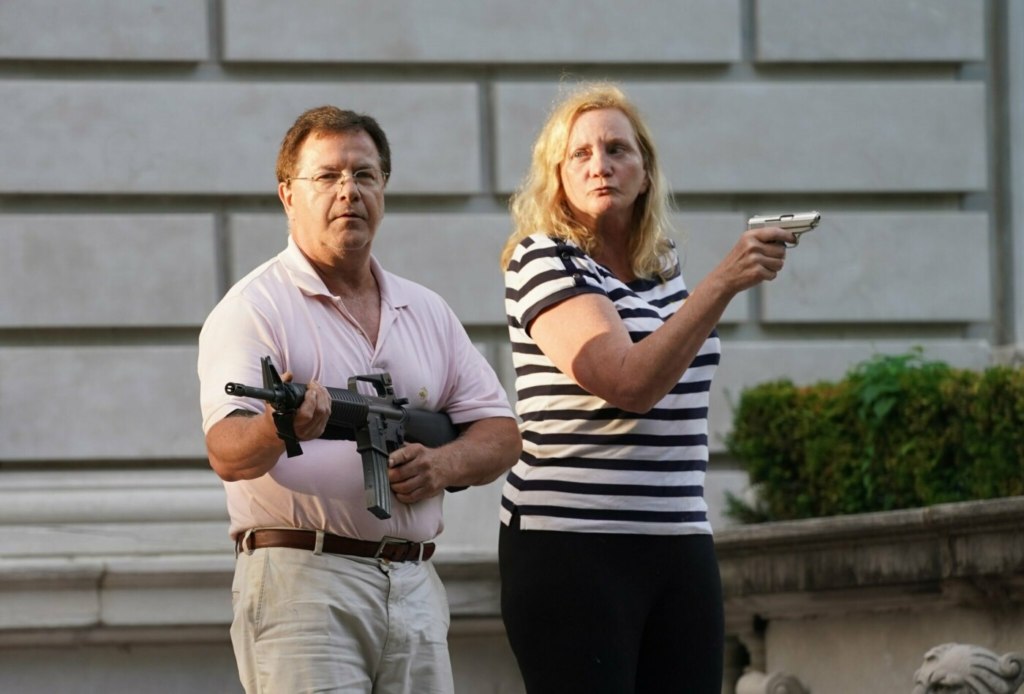
The frame shows two adults in front of a stone wall and bushes. A man in a light pink polo shirt and glasses holds an AR-15-style rifle in front of him; a woman with light hair in a striped T-shirt extends her arm with a small pistol and looks off to the side. Both look composed and serious, and it is exactly this seriousness that makes the frame convenient for parody.
The photo dates from an evening at the end of June 2020 (it is most often dated June 28, although some reports shift the date by a day). The location is a closed private street in the St. Louis area, Missouri. In those weeks, protests were taking place across the United States after the death of George Floyd, and one of the marching columns was heading toward the city mayor's house.
How events unfolded
According to media reports, the marchers entered the private street through a gate bearing signs prohibiting trespassing. The owners of one of the houses came out armed. The protesters claimed they were marching peacefully and passing by the house, while supporters of the couple said the people felt threatened and were defending their property. Accounts of what exactly happened on the street differ, so there is no need to argue about them in the captions of a meme.
The story had a legal follow-up: charges were brought against the couple, the woman later admitted guilt to a minor offense, and state authorities pardoned both of them. For understanding the meme, these details are secondary: jokes are made not from the verdict but from the frame itself. The people in the photo are not named in this text: they are private individuals, and the meme rests on the composition, not on their biographies.
Why the frame became a template
Several things worked at once. First, the symmetry of the poses: two people standing shoulder to shoulder, like the heroes of an action film or the cover of a movie about a pair of robbers. Second, the sharp contrast between the everyday background and heavy weapons: a porch with bushes and a flower bed, where lemonade has been replaced by a rifle and a pistol. Third, the frame has a second layer: it immediately sparks an argument, so the meme itself gathers reactions.
In the first days after publication, a flood of photo edits appeared in both Russian-speaking and English-speaking communities. The man was dressed up as an action-movie hero, the pair were given stereotypical nicknames, and the photo itself was remixed as a still from a TV series. What works in these memes is the form: two determined people in ordinary clothes, ready to defend something very small.
Caption examples
Below are invented examples; all of them rely on the mismatch between the cause and the reaction, not on real events.
“Chat admins when a newcomer walks in and writes ‘hi everyone, please subscribe.’” Here the two become security guards at the entrance, and the cause is a minor act of advertising. The joke works because the chat looks like private territory.
“Me and my neighbor in the shared kitchen when someone once again takes their cup out of our cupboard.” A petty everyday conflict is elevated to the level of defending borders.
“Parents on the day of the exam when someone under the entrance starts playing music.” The caption moves the meme into a familiar setting and plays on a strict regime of quiet.
How to use the template and what to avoid
The frame works best for jokes about overreaction: someone's property, place, or habit that is being defended far too seriously. The caption should be short and name the cause, not the people in the photo.
Do not caption the photo with the names of real people, threats, or calls to action: the image is tied to a real story and a dispute about violence, so jokes about weapons aimed at specific people go beyond the bounds of a meme. If you want a more neutral version, choose an everyday trigger: a queue, a shared fridge, parking in the yard. The picture then stays funny, and political disputes stay out of the caption.