The combat frame becomes approval
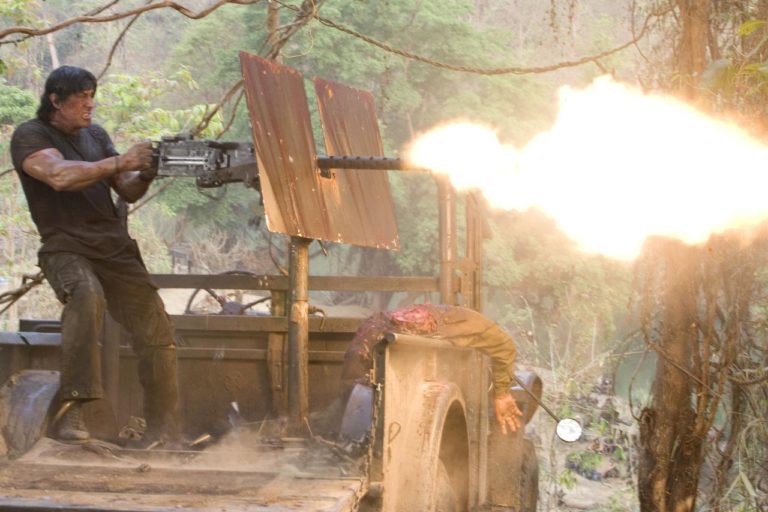
Sylvester Stallone returned to the role of John Rambo in the 2008 film “Rambo IV.” The scene with a heavy machine gun mounted on a vehicle belongs to this installment. The focused hero and the long burst gave internet authors a vivid image of extreme intensity. In remakes, instead of shots from the barrel, thumbs-up icons begin to fly, familiar from the Facebook approval button.
The first publication of such a substitution has not been precisely established. By 2019 the idea had gained a continuation beyond the picture: the artist Tadas Maksimovas created the Emotigun project, a mechanical device that fires physical tokens of social media reactions. In accounts of that work, the Rambo meme is named as a source of inspiration. In this way, the metaphor of “showering someone with likes” traveled from a movie shot to a material art object, without changing its core image: the reaction as a flying projectile.
What is visible before the icons are added
Rambo stands on the left of a car body holding a machine gun aimed to the right. In front of him is a metal shield, and vegetation is visible behind the weapon. On the right, a bright muzzle flash takes up most of the space. The hero wears a dark T-shirt and trousers; his posture is tense and his legs are spread. This image has no blue thumbs-up, hearts, or reaction counter.
The version emptied of meme symbols preserves the direction of the future burst. The space on the right is easy to fill mentally with approval, and Stallone’s silhouette marks the one who hands it out. However, the literal content of the frame remains gunfire from the film. The name “likomet” belongs to a family of remakes and does not mean that the icons are already built into every photo used. This base can also work through a single caption, without additional editing.
One like becomes a whole burst
An ordinary button expresses a small gesture: a person saw a post and marked it. The machine gun turns the same attitude into an active stream that cannot be conveyed by a single tap. So the meme communicates either strong admiration for one find or a desire to approve many posts at once. The dynamics of the weapon set the quantity and speed, and the serious hero gives a perfectly peaceful assessment a comic military scale.
There is a second meaning too: a person eagerly scrolls through a profile and clicks reactions one after another. Then the burst depicts a sequence of identical actions. In this reading, rhythm matters more than the strength of any single judgment. The meme does not require an attack on the post’s author: the approval sign replaces the aggressive content of the scene. It is this substitution that lets the fearsome character become an expression of sympathy, gratitude, or delight at an especially good selection.
Three invented series of approval
An invented example: “Opened my former classmate’s photos with a new puppy and decided to mark just one.” The picture completes the story of a person who could not stop. The second storyline: “A colleague sent instructions where every step really matches the screen.” The likomet becomes thanks for a rare, pleasantly clear result that deserves more than one ordinary icon.
The third variant: “My reactions to twenty photos of a cat that sleeps the same way.” The repetitiveness of the photo does not diminish the enthusiasm, so the approval also becomes a repeated action. All these storylines are invented. They use the direction and force of the original frame but assign the burst a new target: expressing a pleasant impression. For this reading, it is enough to name the specific find in the caption, after which a single like seems to the hero too modest a response.