The frame and its place in the film
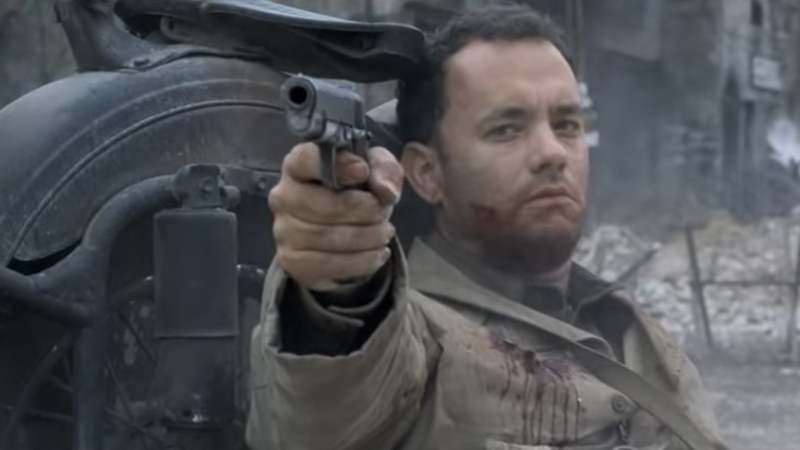
The image shows Tom Hanks in a battered field jacket holding a pistol, his arm extended almost straight toward the camera. A scrape or blood is visible on his face, and there are dark stains on his chest. On the left edge of the frame, the edge of a dark vehicle with a wheel is visible, and in the background there are ruined buildings and haze. The frame looks like a scene from a film rather than a staged photo.
The film “Saving Private Ryan,” directed by Steven Spielberg, was released in 1998. Hanks plays Captain John Miller, the commander of a squad that, after the Normandy landing in 1944, is tasked with finding Private Ryan. In the squad's final battle in a ruined town, the captain at one point is left with a pistol against an enemy tank: this episode became the basis of the meme.
How the frame became a meme
The exact date when the joke first appeared is not known. Early versions with this frame appeared as far back as the mid-2010s, but the format spread noticeably in 2018, when users began captioning the pistol and the tank. These dates should be regarded only as examples of early posts, not as proof of the origin.
Since then, the format has changed several times: from a single picture with a caption to a two-panel scheme. The top panel shows a man with a pistol, the bottom panel shows a threat, and a fitting caption is chosen for it. This layout makes it possible to tell a whole story without words.
How the format works
The format works through scale. The hero is armed with a small pistol, while the opponent is enormous, so the meme immediately conveys the imbalance of forces. The captions transfer this scheme to everyday life: the person is the pistol, the problem is the tank.
An important detail: what becomes funny is not defeat but stubbornness. The hero keeps aiming anyway, and the viewer understands that he is doing it on principle. That is why the meme suits stories about trying to cope with a disproportionate task: household problems, long to-do lists, a “small” request that grows into a project.
The meme falls apart easily if a real person ends up in the role of the tank: then the joke stops being about the situation. It is better to choose abstract phenomena such as the mail, deadlines, repairs or a mood.
Caption examples
Four captions for the two-panel scheme, written independently. In each, the top panel sets up a small action and the bottom panel a huge problem.
Pistol: “One short message in a messenger.” Tank: “A reply to it that has exactly forty points.” The weapon is small, the reaction is enormous, and the viewer recognizes a familiar chat thread.
Pistol: “I'll drink one glass of water.” Tank: “A morning in which everything demanded attention at once.” The joke lies in the shift from a calm intention to the scale of the whole day: the words are simple, but the opponent is huge.
Pistol: “Before bed I'll get back to my book.” Tank: “A TV series that decided now is the perfect time for the next episode.” The caption shows that weak willpower loses to autoplay.
Pistol: “A couple of minutes to tidy up.” Tank: “A wardrobe I decided to clear out completely.” The contrast between the modest plan and the real scale of the work is what produces the laugh.
How to use the template
The format works better when both the hero and the opponent are understandable without explanation. A strong size contrast is the key to success, so it is worth choosing a small action and a conspicuously huge threat.
The frame is convenient for personal irony about everyday situations. If a real person ends up as the tank, the joke stops being about the situation and starts being about the person, so such captions should not be written. It is also not appropriate to use the frame for jokes about real battles and real victims of war: the film's plot remains fictional, and the meme is only about everyday scales.