The film and the famous scene
'Forrest Gump' came out in 1994. Director Robert Zemeckis adapted the novel by Winston Groom, and the lead role was played by Tom Hanks, who won an Oscar for it. The film tells the story of a simple-hearted man who unwittingly becomes a witness to and participant in major events of American history: from the Vietnam War to student protests and the early days of the computer industry.
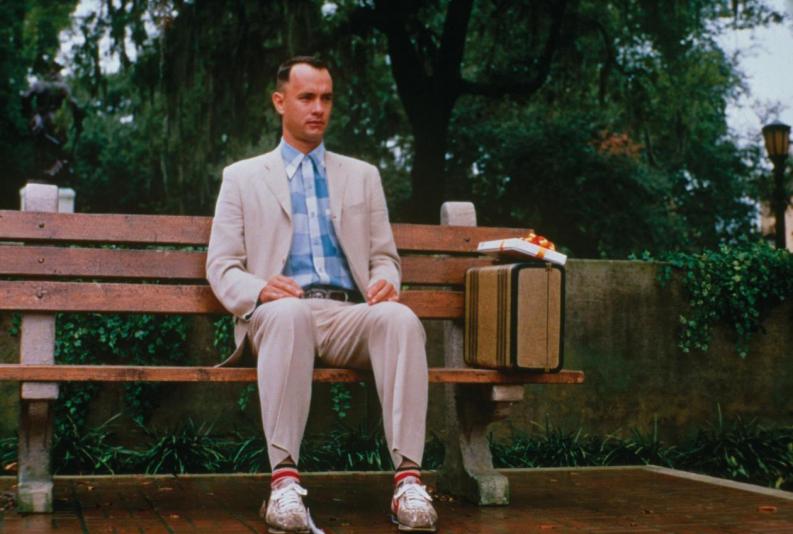
The bench scene is one of the most recognizable in the film. Forrest sits at a bus stop in a white suit and sneakers, a suitcase beside him, and random people sit down next to him and listen to his story. It is precisely these shots that became the basis for the memes: they show a calm posture, waiting, and a gaze directed somewhere into the distance.
Origin of the meme
The exact date when the bench shots first appeared as memes has not been established. The meme likely grew out of the scene's own popularity and out of Forrest's lines, which spread as aphorisms and internet captions.
The film's key line, that life is like a box of chocolates, became one of the most quoted in world pop culture. Around it and around the image of Forrest grew an entire layer of captions in which the bus-stop shot serves as an illustration of everyday wisdom.
Two readings of the image
The meme can be read in two ways. In the first, Forrest looks like a storyteller sharing wisdom: the caption sounds like advice delivered in a calm tone. In the second, the character appears as a lost person sitting and not knowing what to do next. Both readings rely on the same picture, which is why the template suits the most varied situations.
An important feature of the meme is the absence of mean-spirited irony. The film treats Forrest with warmth, and the meme generally inherits that tone. Even when the caption carries a hint of sarcasm, the butt of the joke is not the character himself but the situation the viewer finds themselves in.
How the shot is used
Most often the shot of Forrest appears in comments when someone shares a banal life truth or, conversely, tells a rambling story with no end in sight. The picture serves as a visual frame: the man is sitting, and everyone understands that a long monologue is about to follow.
Variants of the shot differ: some use a close-up of the face, others a wide shot of the bench and suitcase. There are also sets of several frames, each showing a separate emotion. This flexibility helps the meme stay relevant and not grow tiresome.
Why the shot works so well
The shot is recognizable, neutral, and needs no explanation. Viewers of different ages remember the film, or at least its scenes, so the caption reads instantly. That is the main property of a good template: the picture sets the frame, and the caption supplies the meaning.
The meme shows how a film can turn into the language of the internet. A scene that in the movie serves as emotional background turns, years later, into a self-contained sign understood even by those who haven't rewatched the film in a long time.