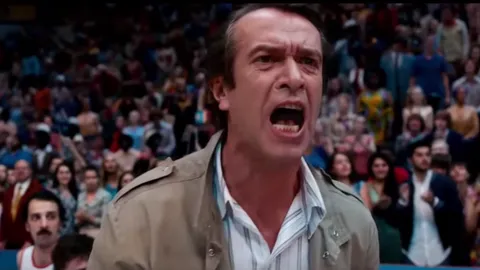
metal-framed glasses and a downward gaze
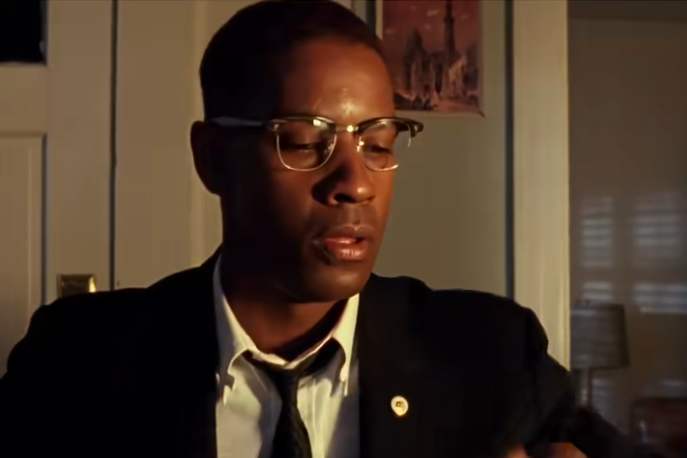
In the frame is a man in a black suit, white shirt, and thin tie. He wears metal-framed glasses, and there is a small pin on his lapel. He is looking down, his brows drawn together, his lips pressed shut: the expression is focused and heavy.
The light is warm, indoor light; behind him a wall with a painting and part of some furniture are visible. The setting is ordinary, without any grandeur, and that matters: the scene reads not as a public speech but as a conversation in which the man is holding himself together by sheer effort.
The film Malcolm X, Spike Lee, 1992
This is a frame from Malcolm X, directed by Spike Lee in 1992, with Denzel Washington in the lead role. The film tells the story of the American public figure.
The scene is built on restraint: the character abruptly tears a sheet of paper, crumples it, slams his palm on the table, takes off his glasses, and rubs his eyes in exhaustion. There are no raised voices — the tension breaks through in a single movement.
the still frame and the video meme with the strike
This frame is the moment just before the strike, so it shows the character's state rather than the action itself. Short videos from 2026 used the whole segment, and the cut lands right on the moment the hand hits the table.
The still frame before the strike is seen more often, but that doesn't mean the meme always cuts off at exactly that moment: the cutoff is a device used in some clips, not a rule for the whole template. The still frame and the video with the strike are not competing forms but coexisting ones of the same meme.
The difference between the two forms is practical. The still frame reads as a pause before a reaction, while the video shows the reaction in full. The same meme exists in both forms, and captions for them are built differently.
the song "Po Glazam" and the occasions of 2026
In January 2026 the clip went viral again: it was edited together with Slava Marlow's song "Po Glazam" ("By the Eyes"), whose lyrics are hard to make out on first listen. The frame was used to depict absurd and ridiculous situations — ranging from everyday mishaps to black comedy.
In this way the scene from the film broke away from its plot and took on a life of its own as a standalone reaction. The frame gets placed wherever someone has to silently put up with something: in meetings, in chat exchanges, in conversations with relatives.
captions for restrained irritation
"Explaining the same thing for the third time. They're listening politely." The caption describes a conversation that is calm on the outside and raging on the inside.
"They said it was a quick question." The frame marks the moment when a person has already grasped the scale of the problem but is still staying silent.
"Opened the document I myself called 'final' yesterday." The frame fits any moment of recognizing your own mistake.
What unites all these occasions is one thing: the irritation is already there, but it can't be voiced yet. The more polite the context, the funnier the contrast.
why the frame reads as restrained irritation
The power here is in restraint. The character doesn't shout or gesture, he only looks down. The viewer understands that everything inside him is boiling, and that is exactly what makes the reaction universal: this is how anyone looks when they have to hold themselves together.
The pause also does work. The frame leaves room for imagination: the viewer fills in for themselves how the scene will end, and that is more powerful than displayed anger. For light jokes the scene is a bit too heavy — real tension reads through it.