An awkward bow to the king of Wakanda
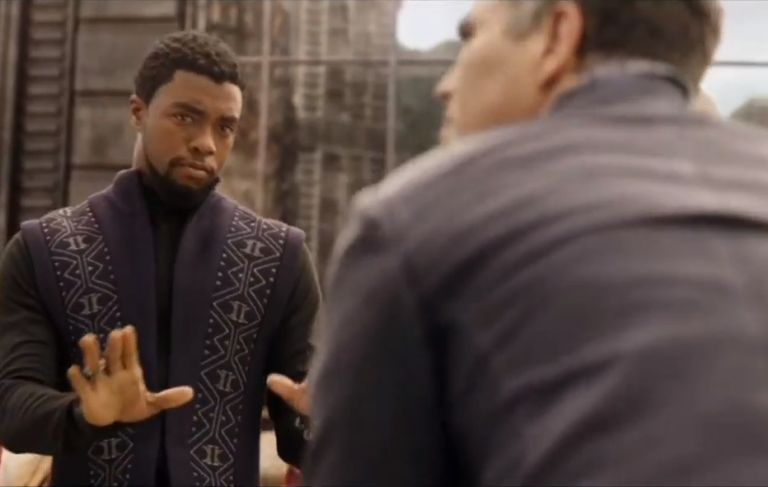
The scene takes place in the 2018 film Avengers: Infinity War. Bruce Banner, played by Mark Ruffalo, meets the King of Wakanda, T’Challa, played by Chadwick Boseman. Before the meeting, Banner asks Rhodey whether he should bow; Rhodey jokes at his expense and answers yes. The attempt to observe the supposed court etiquette therefore immediately turns awkward.
T’Challa interrupts the bow with the phrase “We don’t do that here.” In the original scene, this line removes the excess ceremony: the guest is told that such behavior is not expected of him. In spring 2018 the moment began to spread as GIFs and meme captions, and by June it was already part of a notable wave of jokes on Twitter, including Indian variants. This is a history of the reaction's spread, separate from the film's release date.
Open palms instead of a royal command
In this frame T’Challa stands on the left, facing Banner. He wears dark clothing with an ornament; both palms are slightly raised and open. Banner occupies the right foreground, turned partly away from the viewer. The background with buildings stays blurred, so attention focuses on the gesture and the meeting of two people.
The picture represents a single moment, without printed subtitles or additional panels. Open palms let one read the stop without threat: a small gesture is enough for the other person to understand the correction. In meme use the caption completes what exactly must stop. The facial expression and pose remain restrained, even when the invented rule turns out to be funny or absurd.
A phrase spoken on behalf of a whole community
The key word here is “we.” The speaker does not simply state a preference, but marks a habit of the group and the boundary of a familiar space. The person may have acted quite in good faith, but brought a rule from another environment. That is why the template conveys well the moment of getting to know a company where things a guest considers normal are arranged differently.
The meme easily changes tone depending on what action has been forbidden. If a newcomer reveals a film's plot in the chat, the reaction can express a clear shared rule. If the community rejects carefulness, sensible thrift or a calm conversation, irony arises: T’Challa becomes a representative of a group proud of its own oddity. His calm line gives an absurd habit the look of a long-established order that does not even need explanation.
Three invented local customs
First new situation: someone joins a film club chat and reports the ending before the group watches together. The frame with T’Challa means that here it is customary to leave surprises for other viewers. Second: a newcomer brings store-bought dumplings to a family dumpling-making evening. The same reaction now concerns the ritual of gathering — people assemble to cook together, not just for dinner.
The third situation reverses the meaning: a player suggests first reading the rules of a board game, but the group habitually starts the game and sorts out the rules after the first argument. “We don’t do that here” now defends disorder, as if it were a strict tradition. These examples show why the gesture stays the same while the joke changes: the viewer compares the proposed action with the group's norm and decides whether to laugh at the guest, the hosts or the most unexpected difference between them.