The scene from the ad
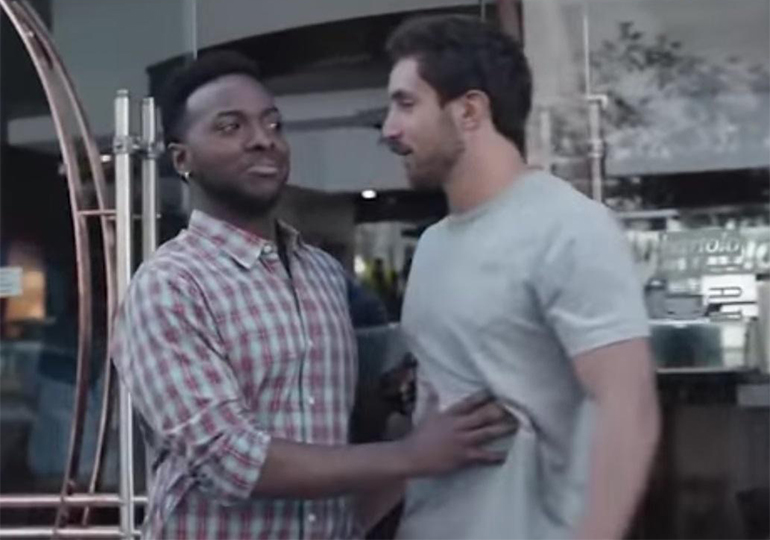
The frame shows two men standing close together on a street, with a glass storefront and a blurred background behind them. On the left, a man in a red-and-white checked shirt, with a serious, slightly tense face, places his palm on the torso of the other man, who wears a gray T-shirt; the second man is turned toward him and looks at his face. The gesture reads as an attempt to stop someone, not as an embrace.
There is no woman in the frame. In the ad itself, the scene is generally understood to relate to an episode in which one man follows a passerby and another steps in. For captions this context is secondary: the template rests on the gesture and the tone of reproach, so it is used even without the original storyline.
What the ad is
The short film “We Believe: The Best Men Can Be” was released in mid-January 2019 as part of a campaign by Gillette, a brand owned by Procter & Gamble. The title plays on the brand’s longtime slogan “The Best a Man Can Get.” The film shows negative models of male behavior — bullying, sexism, harassment, and the habit of brushing things off with “boys will be boys” — and calls on men to step in.
The reaction was sharply divided. Some viewers supported the idea, others saw the film as a rebuke to all men, and there were calls for a boycott. The company announced that for three years it would donate one million dollars a year to organizations working with young people, including Boys & Girls Clubs of America. The broad controversy explains why the frame became recognizable so quickly.
How the template emerged
The two-part format took shape in 2019, soon after the film was released: English-language internet users began substituting any act into the first part and the phrase “Bro, not cool” into the second. Who first assembled this version is not reliably known, so no authors should be named.
The template then spread through meme communities and social networks. It became universal: instead of a real conversation in the frame, any object or act is substituted, and the second part responds with a short reproach. The ironic tone stuck because the original ad was so serious, and the contrast between the pathos of the original and the triviality in the caption became the joke itself.
What the reaction means
The mechanism is simple: the first part describes an action that seems successful or ordinary, and the second shows the reaction of a friend who sets a limit. The phrase “Bro, not cool” sounds friendly, but in meaning it is a short moral remark. The joke rests on the contrast between a warm form of address and a stern judgment.
It is funniest when the second part judges something that does not deserve judgment: a trifle, a weakness, or a personal habit. The tone shifts from serious to everyday, while the phrase itself stays the same. The viewer sees irony of scale: a moral rebuke is applied to nonsense.
That is why the template works best for everyday situations and habits. If the subject involves real bullying or violence, the irony stops working and becomes inappropriate.
Caption examples
The examples below are invented for the template and show how the roles are split between the parts.
First part: “Opened the work chat again on the weekend.” Second: “Bro, not cool.” Here the second part plays the role of conscience, and its short line is funny because the strictness is aimed at the smallest habit.
First part: “I’ll just watch one episode.” Second: “Bro, not cool, that’s episode three.” Counting episodes turns a promise into escalation, and the second part does what friends do: keeps count on time.
First part: “This is almost a healthy salad, there are cucumbers in it.” Second: “Bro, not cool, that’s pizza with cucumbers.” The effect rests on the first part trying to justify the act, while the second refuses to accept the argument.