Red jacket and a neon sign
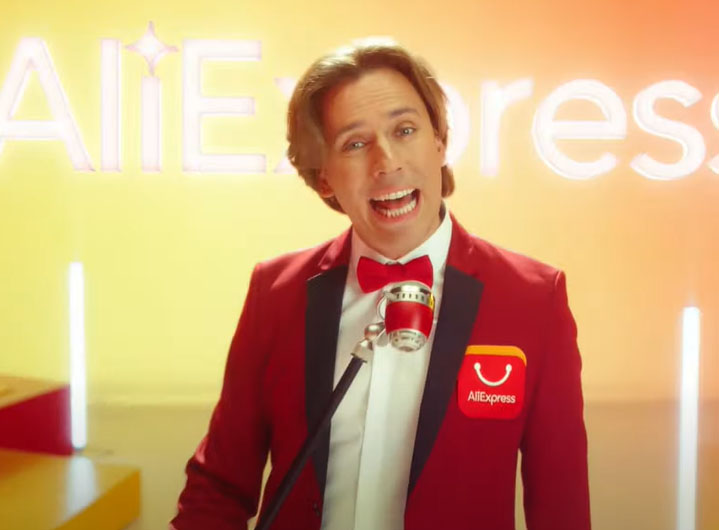
The frame shows pop entertainer Maxim Galkin in a bright red jacket with black lapels, a white shirt and a red bow tie. A badge with the AliExpress logo is sewn onto his chest, and a microphone on a thin stand stands in front of him. He is singing: his mouth is wide open and his eyebrows are raised. Behind him is a glowing yellow-orange wall with the marketplace's name in huge letters.
The look recalls an evening show or a master of ceremonies, but in a bright, deliberately grotesque delivery. Exactly this kind of frame suits parodies best: the pose and the expression are already theatrical in themselves.
What is known about the ad campaign
Galkin was announced as the face of Russian AliExpress in August 2020. The first ads came out then: one about the platform's wide range, another about the summer sale. For the campaign, new lyrics were written to the tune of the hit by the Romanian group O-Zone, “Dragostea Din Tei”, known in Russia as “Ma-iya-khi”, and they were built around the slogan “Yes, you can” (“Da, mozhno”).
The ads were later continued for major sales, including the annual 11.11 sale. The details of individual versions of the clip and the list of the artist's looks in different releases vary from one ad to another, so they are not given here.
How the ad became a meme
The tune proved too catchy: the song was quoted in comments, and the video itself was rewatched for the melody. Viewers began to remake the clip: they laid it over other scenes, rewrote the lyrics, and played it backwards.
The date of the first parody is not established, and the scale is hard to estimate: there are no clear statistics. It is known only that the ad and its remakes were actively discussed in autumn 2020.
Why parody is so enjoyable
The ad is itself built as a grotesque: excessive joy, bright colors, theatrical facial expressions. Such material is easy to push to absurdity, because the line between the original and the parody is almost erased.
Another factor is the recognizability of the melody. For anyone who knows the original song, the caption fits the rhythm by itself. That is why memes often contain not just a funny text but lines you can sing.
Caption examples
“When I bought three things I didn't need and one I did at the sale.” The caption describes a typical buyer's reality, and the joyful face of the hero turns into irony about oneself.
“Me when the item is in the cart, but delivery takes until next year.” The contrast between the cheerful image and the long wait.
“The boss at the weekly meeting, announcing there's no bonus but there is a sale.” Here the advertising enthusiasm becomes a way of showing inappropriate cheerfulness.
“My wallet, when the fifth sale of the month begins.” The joke makes the wallet, not a person, the hero.
How to use the picture
It works best for stories about shopping, discounts, waiting for parcels and household spending, that is, anything connected to the ad's own theme. For a neutral tone, a one-line caption is enough.
Don't present the caption as the artist's own words: it is a separate parody of his advertising persona, not his statement. A noticeable detail of the frame also helps: the badge with the logo on the chest and the microphone in front of the face turn any caption into a performance.