Laboratory, lab coat and mustache
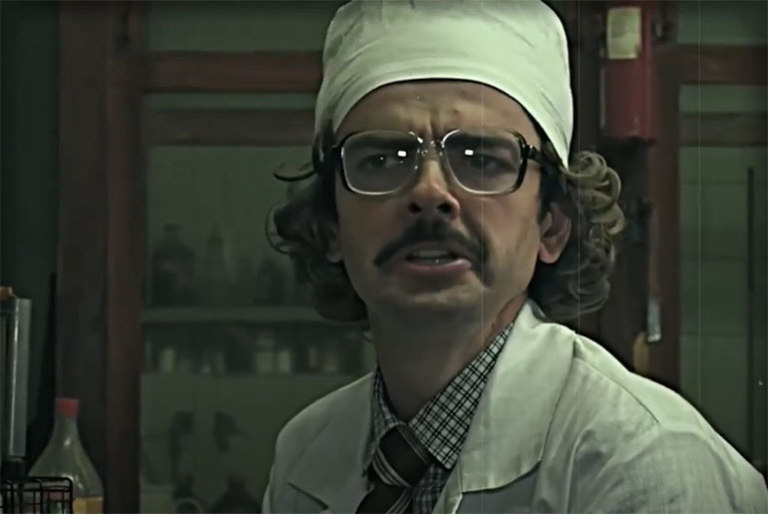
The shot is taken in a room resembling a lab: behind the figure are shelves with dark flasks, on the right in the background is a red fire extinguisher, and at the bottom left the edge of a bottle with a red cap is visible. The hero looks straight into the camera: he wears a white medical cap, thick glasses in heavy frames, a bushy mustache, and curly hair down to his shoulders. Over a checked shirt with a striped tie he wears a white coat.
The picture is slightly grainy, with pale vertical stripes and blurred edges. This was done on purpose: the project is styled as old video footage and late-Soviet cinema.
What “Vnutri Lapenko” is
This is a comedy project in which actor Anton Lapenko plays all the characters. It grew out of short videos on Instagram, and as a series for video platforms it started in December 2019; the screenwriter and director are credited as Alexei Smirnov. The aesthetic combines images of the 1980s and 1990s and parodies the genres of late-Soviet television.
Among the characters are road worker Igor Katamaranov and a journalist who hosts the program “Tayna Dyry” (“The Mystery of the Hole”). The engineer first appeared in the author's early Instagram clips and then made it into the series.
Where the phrase comes from and what is known for sure
The phrase “They'll give me such a bonus for this invention” is tied to the engineer character. The hero speaks with a serious air about his invention and expects a reward. The exact air date of this clip and the order of the episodes are not established, so it can be called the start of the meme only tentatively: by 2020 the phrase was already being widely quoted.
For the joke itself, the specific episode does not matter; what matters is the image: a person who takes pride in his work and is firmly convinced it will be rated at the highest level.
How the joke works
The meme's meaning rests on the gap between self-assessment and reality. The engineer talks like a person who made a discovery of the century, but the “invention” may turn out to be an ordinary trifle. The more modest the object, the funnier the confidence.
The intonation adds further comedy: the speaker is a little boastful, slightly breathless with joy, yet remains serious. This is a recognizable type of the “self-taught genius”, familiar to many from life and from film.
Caption examples
“I figured out how not to drop my phone on my face in bed: I put it on the floor.” The solution is obvious, so the hero's pride looks especially comic.
“Found a way not to be late for work: I leave early.” It's funny because the discovery is banal.
“Poured boiling water on the noodles and covered them with a plate: now it's a technology.” An everyday trick is elevated to the rank of an invention.
“Made a table with two columns and not a single formula, and the bonus is guaranteed.” A joke about office enthusiasm. Each example shows one thing: a simple action is presented as an achievement, and the face in the frame makes the words convincing.
How to use it
The meme suits captions for life hacks, homemade solutions and workplace “efficiency proposals”, when the author deliberately exaggerates the importance of their find. It is better to choose real trifles: the smaller the benefit, the stronger the effect.
If needed, the caption can be left without explanation: the quote and the frame with the engineer are instantly recognizable to a knowing viewer. For everyone else, a short first line naming the “invention” is useful, with the phrase itself placed on its own line at the end.