What is visible in the frame
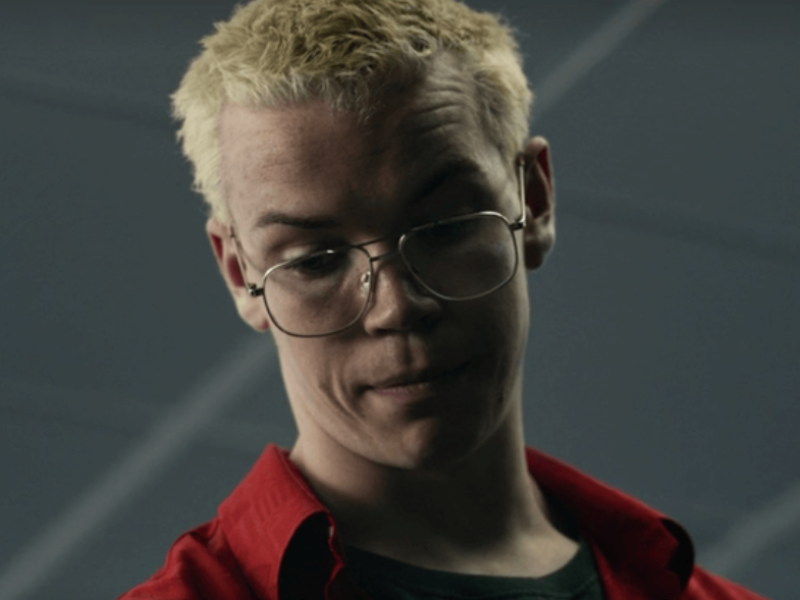
The frame shows a young man with short, almost white hair and glasses with thin metal frames. His head is tilted down, his gaze is lowered, and his lips are pressed into a half-smile that reads as calm displeasure. He wears a red shirt with an open collar over a dark T-shirt, and the background is gray and blurred.
This is Colin Ritman, played by the British actor Will Poulter. This expression lets the frame be read both as condescending support and as a mild reproach.
Where the frame comes from
The film “Black Mirror: Bandersnatch” premiered on Netflix on December 28, 2018. The action takes place in Britain in July 1984. The protagonist, Stefan, played by Fionn Whitehead, tries to create a computer game, while the viewer chooses his behavior for him.
Colin works at the company Tuckersoft and is considered a recognized game developer there. For Stefan he becomes a mentor and friend, and depending on the viewer's decisions his fate unfolds in different ways.
How recognizable the frame is
For those who have not watched the film, the picture remains understandable: the glasses, light hair, red collar and lowered gaze themselves suggest that the hero sees something unsuccessful. For those who have watched it, there is added memory of endless returns to the forks in the road, which are the main feature of “Bandersnatch.”
It is precisely this double reading, naive and informed, that explains why the frame has outlived its moment. One viewer sees a condescending advisor, another recalls the game mechanics, and both laugh at the same thing.
The mechanics of return
An important feature of the film is that some forks are considered wrong. A choice that leads to a dead end sends the viewer back to the original moment, and now the decision has to be made with knowledge of the consequences. It is exactly this game mechanic that became the basis of the joke.
The phrase “Wrong, try again” on the Russian internet connects the frame with Colin and this situation. The author of the Russian caption and the date it appeared are not established, so the meme cannot be tied to a particular week.
Why it is funny
The joke rests on the contrast between the hero's calm face and what is being communicated: a mistake is acknowledged without drama, as if it were a trifle. A feeling arises that life offers a reset, as in a video game.
The meme also works because of recognizability: many people repeat the same unsuccessful action in hope of a different result, and the character in the picture seems to pass judgment on this without anger.
Examples of captions
“Opened the fridge for the third time in ten minutes, just in case something appeared” — the caption turns everyday repetition into a hopeless attempt.
“Wrote to the old work chat ‘hi, how are you’ again” — the picture adds gentle disapproval.
“Sent an email without attaching the file and immediately got a reply ‘see attachment’” — the meme emphasizes that it is time to step back.
“The second diet this week starts on Monday” — an ironic verdict on a leisurely retry.
How to use the template
The picture is convenient to send to a friend who admits their own mistake. Do not accompany it with long text: a short caption, or none at all, works better.
For a funnier effect, caption the picture with a situation where there is no “right” path and the choice consists of equally absurd options.