A stage, blue curtains, and wide gestures
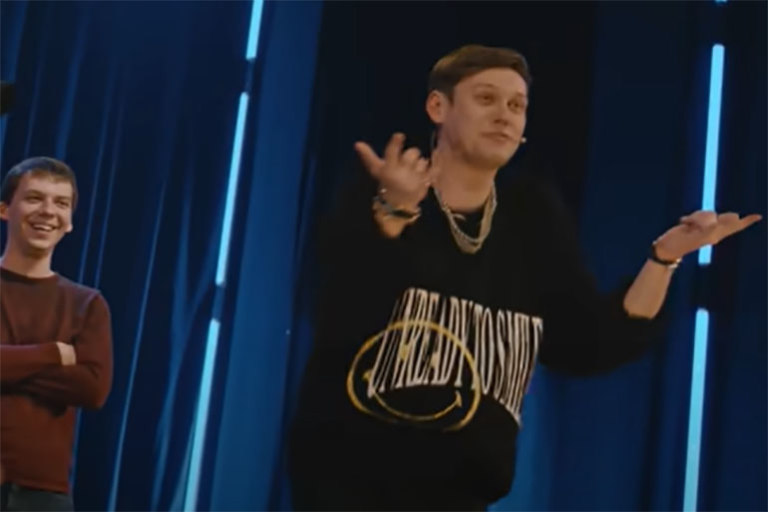
The frame shows a stage with blue curtains and vertical light stripes. In the center is a young man in a black sweatshirt with a yellow smiling face, chains around his neck, and a headset microphone visible on his cheek. His arms are spread out in a relaxed, almost dance-like gesture. In the left corner a guy in a burgundy sweater is laughing.
From one frame you cannot tell what is playing at that moment, so the joke rests on the pose: the man is clearly performing and clearly pleased with the effect he has made. The man in the frame is identified as Anton Shastun, a participant in the Improvisation show on TNT.
What is known about the origin
The phrase came out of a show format in which participants make up scenes and songs on the spot on the host’s prompt. In one episode Shastun delivered a rap in which he addressed a girl from the audience, and viewers picked up the line about the sixteenth row with the English “how do you do”.
The exact season and episode could not be reliably established. Retellings contain versions about who the verse was addressed to, but there is no confirmation in reliable sources, so these versions cannot be treated as facts. The line is part of the game and the number, not a message about anyone’s personal life.
From broadcast to remix
The segment with this line was turned into a short musical remix. On music aggregators it is listed as “ey devchonka v 16 ryadu (Shastun remix)” (transliterated) under the artist name improru; this is data from music platforms, not the words of the remix’s author.
The earliest TikTok videos found are dated by their identifiers to late June and July 2021. These are only the earliest examples found, not a proven first publication. This is why the meme is dated to 2021.
Why the line sticks
Three things work together. First, the exact address: not “girl” but specifically the sixteenth row, as if the speaker sees the hall from the stage. Second, the casual English “how do you do”, used here as an affectedly polished greeting. Third, the rhythm: the remix is short and repeats, so the micro-stories become clearly visible on the loop.
How the joke works
The meme is built on the gap between a loud gesture and a modest situation. The music sounds like an address to the hall, but on screen there is usually something ordinary: a person at a table, a cat, a queue. The viewer recognizes the line before they finish reading the caption, and the laugh comes when they put the pathos next to reality.
The second mechanic is role. The caption assigns someone a place in the “16th row”, making them the object of attention and the speaker a star who dared to speak up.
Captions for your own clip
“Me when I notice in the meeting room that the coffee was brought only for me.” The joke is that the scale of the triumph is tiny, while the intonation is that of a concert.
“Hey, girl in row 16: that’s my cat on shelf 16 of the wardrobe.” A shift from expected romance to everyday life: instead of a hall, a shelf of clothes.
“My inner voice at the office party while I stand silently with a plate.” The contrast here is between inner confidence and outward awkwardness.
“Bus: hey, driver in the first seat, how do you do?” The row number is replaced with a transport version, and the sound immediately gets a new addressee.
How to use it
The frame works best as a reaction to someone’s overconfident move or as a caption for one’s own “entrance on stage” in everyday life. Do not attribute to the frame words that are not visible in it, and do not replace a real person with an invented story about their relationships: the joke’s plot is fictional, not biographical.