The song came before the video
The song appeared in March 2018. Even then its title was attached to photos in which something blue turned up: clothing, lighting, objects around a person. For this version of the joke, four words and a suitable color were enough. The content of the picture could have nothing to do with the song's plot: the recognizable title became a caption for someone else's small story.
In late April a music video appeared, presented on the “Evening Urgant” show. The video was made with the participation of the show's team, Ivan Urgant, and Alexander Gudkov. Kirkorov played a young hooligan, while other celebrities got unusual roles: for example, Olga Buzova became a cashier. Thus specific faces, costumes, and gestures were added to the game with the title, which could be cut from the video and used separately. The March spread of the phrase and the April success of the frames belong to different stages of the story.
Orange hood, blue light, and a sharp gesture
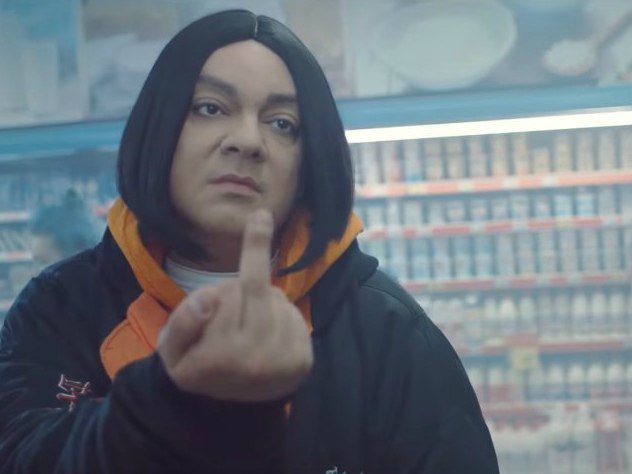
In this frame Kirkorov is shown in close-up against shop windows. The straight black hair of the wig frames the face, an orange hood peeks out from the dark outer top, and a middle finger is raised toward the viewer. The song's lyrics are not printed here, so the mood is conveyed above all by the pose. The frame can work as an irritated reply even for someone who does not remember the melody.
The image has been compared with the rapper Face: the resemblance is created by the hairstyle, clothing, and deliberate defiance. Still, it is Kirkorov in a role, not a photo of a young rapper. It is precisely the recognition of a grown-up pop performer that strengthens the joke. His habitual stage solemnity collides with the behavior of a character who wants to demonstratively break the rules of decency.
Two ways of talking about mood
The title and the freeze-frame offer different tools. A caption about the color blue allows building a calm visual absurdity: a person's state is suddenly measured by the shade of a T-shirt or the contents of a pencil case. The chosen frame acts more sharply. It depicts a refusal to answer politely, fatigue with requests, or a sudden readiness to behave defiantly. In correspondence, such a picture replaces a line the interlocutor would rather not write in words.
Blue can also mean sadness, nighttime lighting, or simply the literal color of a thing. Sometimes a colloquial meaning related to alcohol gets involved, but one shade is not enough to describe a character's state. The humor arises from the chosen connection between caption and picture. If you use exactly this gesture of Kirkorov's, the focus usually shifts from the color to the wish to wave off what is happening.
Three new reasons for blue mood
The first scene can be built around a printer: a person wanted to print one neat document, but the device smeared the whole sheet with blue stripes. The song's title under a photo of the result turns a technical malfunction into the mood of the machine itself. Here no defiant portrait is needed: the literal color has already told the story.
In the second scene, friends agreed to dress modestly, but one participant showed up in a bright blue raincoat. His photo with the song's title expresses the confidence of a person who considers his choice quite festive. The joke rests on the mismatch between the shared dress code and his personal sense of beauty.
The third example suits this freeze-frame: “When, after the third retake of the group photo, they asked me once again to smile more naturally.” The raised finger depicts the moment when the model's patience ran out. Kirkorov becomes the performer of someone else's reaction, and knowledge of his usual stage image makes the refusal even more expressive.