What the frame shows
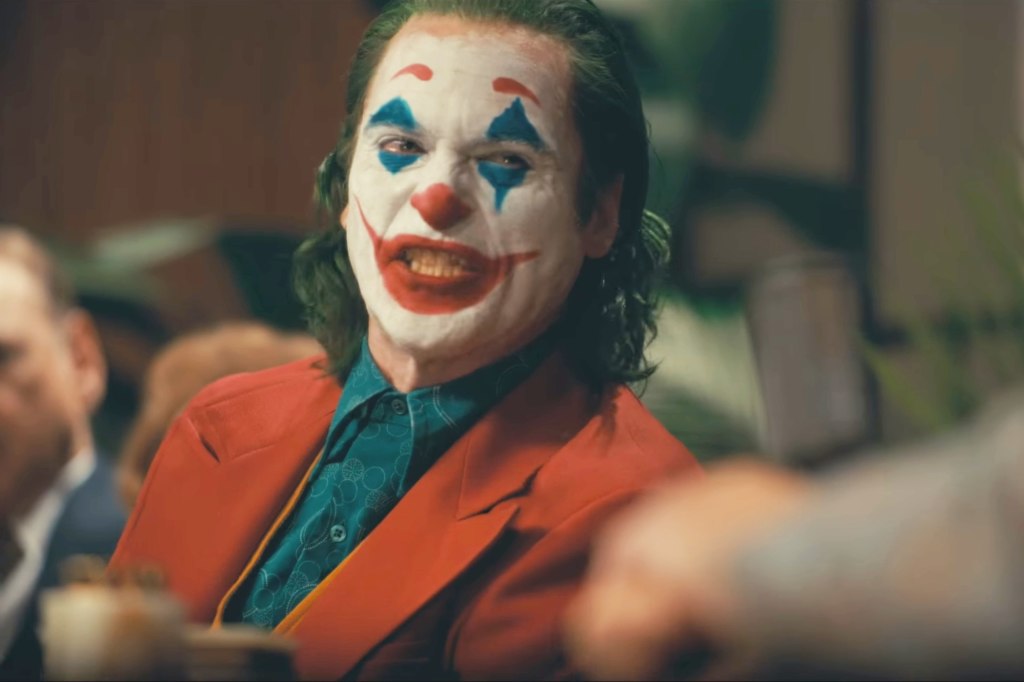
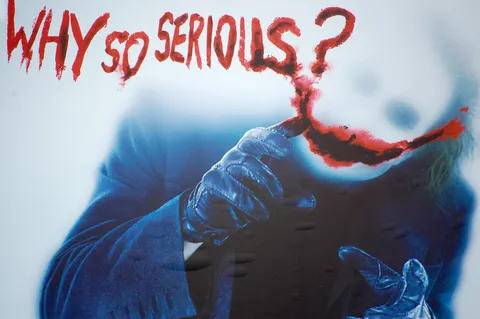
A man in clown makeup: a white face, a red nose, blue diamonds around the eyes, red eyebrows, and a wide scarlet smile. His hair is green, and he wears a red jacket over a green patterned shirt. He sits in a hall where people's figures are blurred in the foreground, and green plants are visible on both sides. His expression is a smirk with parted teeth.
This is Joaquin Phoenix in the role of Arthur Fleck. It is hard to identify the exact scene from the frame: there is no talk-show studio in it, and this picture is used as an image, not as a quote.
Where the line comes from
The film “Joker” came out in 2019, directed by Todd Phillips. In the final scene, Arthur goes on a talk show hosted by Murray Franklin, played by Robert De Niro. He asks what you get when you cross a mentally ill loner with a society that has rejected him, and answers himself: you get what you deserve. Right after this, the hero shoots.
The scene is grim and cruel, so in the original the words sound like an accusation. In memes, however, the line keeps only the moral “everything goes according to merit,” while the violence stays off-screen. It is worth remembering this if you joke about something serious.
How the template works
The meme rests on ambiguity. The same phrase can be a reproach (“you didn't listen to advice, and here's the result”) or a congratulation (“you prepared for a long time, and everything worked out”). Arthur's facial expression, calm self-satisfaction, fits both interpretations.
The caption sets the tone: first the situation, then the line. The more mundane the situation, the stronger the contrast with the grim source. It is a universal reaction frame: it does not require knowledge of the film, only the general intonation of “it all makes sense.”
To keep the caption from losing its force, pick an event that looks like an inevitable pattern: a late reply in a chat after a long silence, a smug “I told you so” from a friend, or an outcome a person has been heading toward for years. Then the expression in the frame reads as a sign of “well, I thought so,” rather than a cruel smirk.
Invented captions
The examples were invented for this article. “Didn't save the file all day, and then the computer shut down” is a warning everyone will recognize. “Spent the weekend cleaning up, and guests came and said your place feels cozy” is a reward for effort.
“Took out a loan for a gadget ‘just in case’” and “Went to the gym for two months and finally did a pull-up” are two opposite outcomes under the same picture. For contrast you can make a pair: “What I promised” and “What I got.”
Tips
Put the picture after the situation, not before it: the verdict works as the final line. The caption should be short, preferably without complicated turns of phrase.
Do not apply the template to real tragedies or violence: the original scene is connected to a murder, and the joke stops being harmless. Everyday trifles, work, study, and workplace failures are a good fit.
It is also useful to remember that the frame itself carries no plot: without a caption it looks like a portrait of a cheerful clown at some party. That is why the whole joke is built on words, and a good caption must be concrete enough for the reader to picture the situation without explanation. One precise example is better than a general moral about justice.