What is in the frame
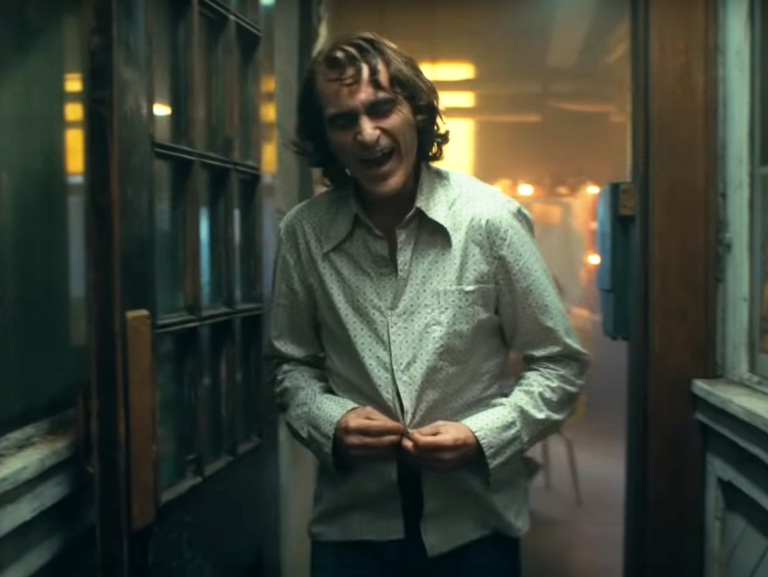
A man with tousled dark hair walks down a narrow, dimly lit corridor. He has no makeup: he wears a light shirt with a small pattern, and his fingers are fastening a button at his chest. His mouth is open and his eyes are narrowed; he is laughing, visibly strained. On the left is a glass door with a wooden frame; on the right, yellowish light and gray smoke or dust.
This is not the famous image with makeup and bright clothing, but the “human” version of the character, before the transformation. Precisely this kind of frame is usually used for memes: the laughter is visible, and the context of the scene is enough for the sound to be swapped out.
Where the scene comes from
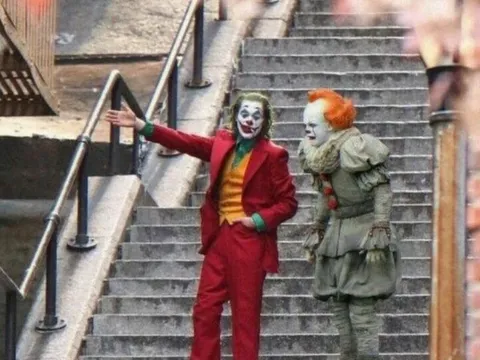
“Joker,” directed by Todd Phillips, was released in early October 2019. The lead role, Arthur Fleck, was played by Joaquin Phoenix. The film provoked much controversy and discussion, and the scenes of the hero laughing became some of the most memorable.
Specific plot details of the scene are not needed for the meme. It is enough to know that the hero's laughter in the film is unsettling and uncontrollable, and the whole joke is built on that contrast.
How the format emerged
Jokes with swapped laughter appeared on Twitter on October 7–8, 2019. The first viral example was posted by user @ryanheezy: he replaced the hero's laugh with the laugh of actor Seth Rogen, and the post collected hundreds of thousands of likes. Other versions followed: with the laugh of basketball player Kawhi Leonard, Peter Griffin from “Family Guy,” Bill Hader, and anime girls.
Another example that was called the most frightening was the laugh of Janice from the series “Friends.” In Russian-language online communities the theme was quickly picked up too and given titles like “Joker laughs like…”.
Why it is funny
It all rests on the gap between picture and sound. The viewer sees a man on the edge and expects a chilling cackle, but gets a familiar voice that had nothing to do with the drama until then. The brain receives two messages at once and cannot reconcile them, and hence the laughter.
Recognizability also plays a role. The more distinctive the voice of the substituted figure, the stronger the joke. The laugh of Peter Griffin or Seth Rogen is recognized instantly, so a title in the video heading is enough.
Examples of titles and captions
“Joker laughs like my alarm clock on Monday”: an everyday, recognizable variation. “Joker laughs like a coffee machine”: a mechanical sound instead of a hysterical laugh. “Joker laughs like grandma at a birthday party”: a warm, homey contrast. “Joker laughs like a chat notification”: a joke about modern life.
Good versions pick a sound that clearly differs from the original in mood but is close in rhythm, so the edit matches the actor's movements. A sound that does not match the facial expression quickly breaks the effect.
How to use it
For self-made editing, two things matter: a clean scene without other people's sounds and precise synchronization. If you are simply captioning a frame, focus on the sound: write what exactly the hero is “laughing” like.
The joke is not about illness or about the film itself. It is about playing with sound. It is better to avoid captions that mock real mental states of people.