What's in the shot
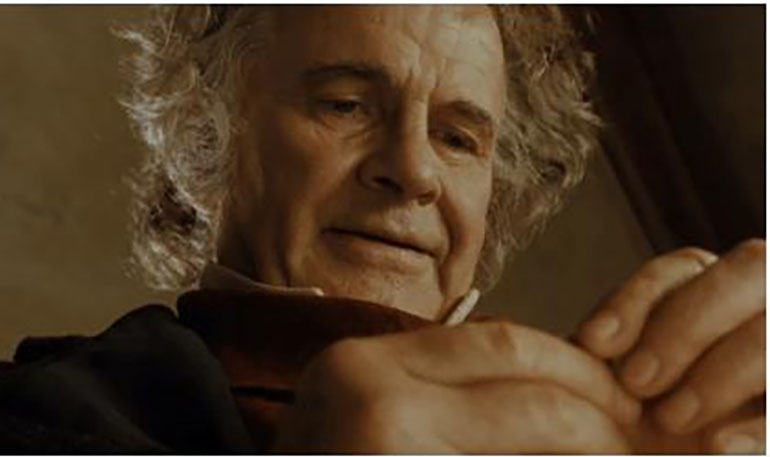
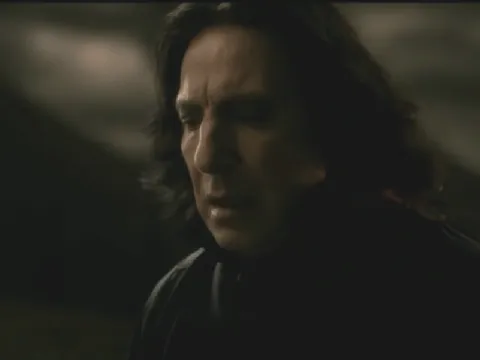
The face of an elderly man with gray curly hair fills the upper part of the frame. He's looking down at his hands, holding something small: a light-colored tip of the object is visible near his chin. The shot has a warm, brownish tone, with soft lighting, as in a dim room.
Some descriptions of the meme mention "frames" in the plural, but this image shows only one: the caption or the second half of the template is something the user adds themselves. The classic meme format usually pairs two shots — a look at the ring and a look at the interlocutor — but the second one isn't visible here.
A scene from the 2001 film
The scene is taken from Peter Jackson's The Lord of the Rings: The Fellowship of the Ring (2001). Bilbo Baggins is played by Ian Holm, and the wizard Gandalf by Ian McKellen. In the story, Bilbo is about to pass on the One Ring and hesitates over whether he should part with it, even though Gandalf understands how dangerous it is.
According to meme encyclopedias, the character's line goes something like, "Why shouldn't I? Why shouldn't I keep it for myself?" In the book and film, the Ring itself is shown as an object that corrupts its owner, which is why the hesitation feels more dramatic than its everyday meme equivalents.
Timeline of the meme
The earliest known Western jokes based on the two-frame format date back to 2013. A new surge happened in April 2021 on Reddit, from where the format spread further. That doesn't mean the meme went unused in between — it simply became mainstream at that point.
If you come across a claim about the exact day of the first publication, treat it with caution: only the general picture of the two waves of popularity is reliably confirmed.
Captions and how they work
Example: "Promised myself I wouldn't buy a new game until I finished the old ones. But there's a 70% discount, though." The character's hesitation here jokingly disguises a decision that's already been made.
Example: "Well, one episode before bed definitely won't hurt me. Why not?" The device works because the example is familiar to almost everyone.
Example: "Eating the last piece of cake saved for breakfast: after everything else, why not." The gravity of the shot doesn't match the triviality of the act.
A self-deprecating example: "Texting an ex at midnight: just one message, what's the big deal?" The caption sounds like self-justification rather than advice, and that's where the joke's honesty lies.
How best to caption it
A caption works when it names a decision that's clearly not worth making but is very tempting: after all, Bilbo is also telling himself why he could just keep the ring. The smaller the real reason and the louder this inner monologue, the funnier the gap between the gravity of the shot and the mundane triviality of the situation.
A short question like "why not?" under the shot works better than a long explanation: the ring in Bilbo's hands already reads as hesitation, and the text only needs to confirm what's already visible on his face. This is a scene from a film, so the caption should speak about your own choice, not about the character or the actor.
If the joke is structured as a dialogue, you can turn the single shot into two lines: a question from another person on top, and "why not?" on the bottom. The shot is dark, so light-colored text with a thin outline reads best. To keep the joke from becoming a cliché, it's worth picking a weakness that's genuinely familiar — sleep, sweets, shopping, texting — and describing it matter-of-factly, as if it were just an ordinary daily decision.