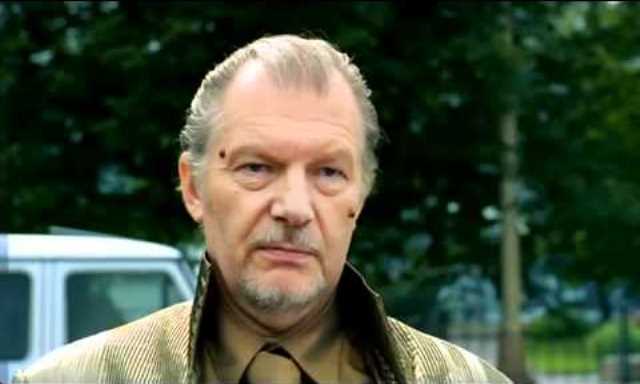
Frame from Down House
The image shows a general with light hair combed back, a mustache, and a short beard. He looks straight ahead, with blurred greenery and a white car behind him. This is a portrait still, not a neutral picture of an invented character. The source is linked to Roman Kachanov’s film Down House (2001), a free and deliberately eccentric reworking of Fyodor Dostoevsky’s novel The Idiot. General Yepanchin was played by Juozas Budraitis, while the character’s voice was provided by Boris Khimichev, so the face and the spoken line belong to different actors. In the image, the general wears a shirt with a tie and a light jacket; his lips are pressed together and his gaze is directed at someone across from him.
Yepanchin assesses Prince Myshkin, played by Fyodor Bondarchuk, after a conversation about marriage and the prince’s declaration of love for Nastasya Filippovna. The adaptation moves the characters of The Idiot into an eccentric modern world, so the sharp phrase fits the film’s overall manner. In internet communication the original plot reason has dropped away: the line began to be attached to entirely different characters and actions. The known origin of the quote in the 2001 film does not give an exact date for the appearance of the first image macro with this portrait.
Why the combination of face and words works
The face in the frame barely changes: the hero neither shouts nor waves his arms. Against this calm background, the obscene construction sounds like a dry verdict, and the adjective “fairytale” unexpectedly turns an insult into an almost fairytale title. This clash of registers creates the comedy. It is an emotional hyperbole for a plainly absurd act.
How a movie quote became a standalone verdict
The phrase lives on without the image: it is recognized by its unusual word combination. The neutral “fairytale” usually promises a miracle or praise, but here it magnifies the absurdity. The result is an almost honorary title awarded for a spectacular failure. The portrait adds a second voice: one person makes a mistake, while another has already grasped its consequences and looks on with grim bewilderment. At the same time, the meme’s judgment applies to the chosen act; in the film, the general judges the prince from his own limited point of view rather than formulating a general assessment of the hero.
The variant “fairytale idiot” keeps the same rhythm and appears in Interns, where Doctor Bykov, played by Ivan Okhlobystin, uses a softened formula. Okhlobystin also took part in creating Down House and played Rogozhin. This echo explains why the phrase is perceived as a quotation even when the swear word is replaced. Its recognizability rests on exaggeration and the tone of a dry sentence.
Made-up examples
A friend booked a train for yesterday’s date and cheerfully sent the ticket with the caption: “Fairytale [expletive], but at least it has a route.” In the office chat, someone sent a report with no single attachment, then asked for feedback on its completeness; the frame can get the text “The general has already passed judgment.” A third option: the hero bought ice cream and put it in a hot trunk; the dry caption under the portrait makes the mistake obvious. In every case, the joke lies in the scale of the verdict, which is far larger than the everyday slip.
A joke can also be built on an especially confident excuse: the hero mixed up time zones but insists the meeting took place according to his personal calendar. Under the portrait, the line “At least I arrived before everyone else, in another country” is enough. The general becomes a witness to absurd logic, and the reader fills in the famous verdict themselves. This version uses the recognizable face and the character of the quote even without repeating it literally.