A frame after a long road
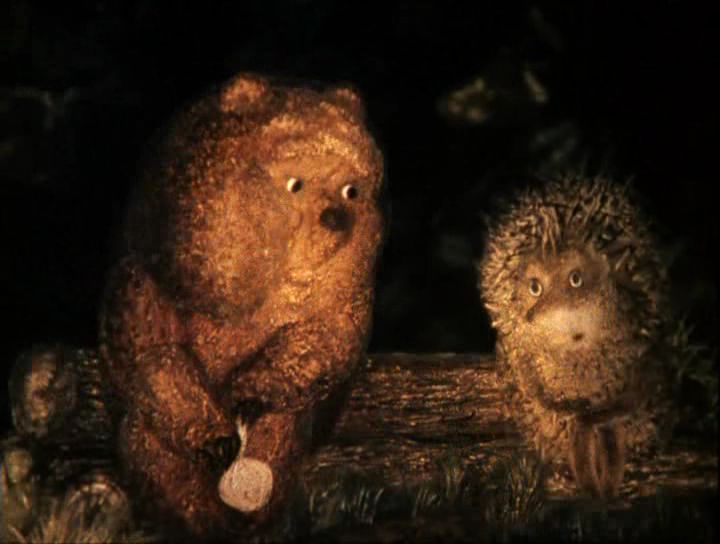
Hedgehog in the Fog was directed by Yuri Norstein from a screenplay by Sergei Kozlov; Soyuzmultfilm released the film in 1975. In the frame, the Hedgehog and the Bear sit side by side in a calm setting. Their stillness and the warm light belong to the cartoon itself; the crude phrase “And that’s it, [expletive]” does not come from its dialogue. The online version changes the tone of the scene: instead of a quiet moment, the viewer is offered an indifferent verdict after an alarming story.
The August version
The earliest known version of this construction was published on August 26, 2018, in the MDK community, and on the following day similar posts appeared in other VKontakte communities. Its author is unknown. The early version differed from the format that later took hold; in the familiar version, the first part sets up a conversation, and a separate frame with the Hedgehog closes it with a short phrase. This difference matters: the meme did not grow from one unchanged picture but from a reinterpretation of the final episode, which was at first used more freely and later came to be recognized by the stable pair “So what?” — “And that’s it…” The original JPG remains a silent frame without captions.
How the short ending works
In the familiar version, the Hedgehog tells of an event, the Bear briefly asks “So what?”, and the answer draws a line. The question demands not continuation but a result; therefore the last phrase can turn out harsher than the whole backstory or, on the contrary, release the tension. Imagine that after a long story about a broken-down car, the line “And that’s it, we got there by bus” brings relief; after a list of summer plans, the same ending can sound like disappointment. The frame does not impose one tone: its silence leaves room for both a sad and a mundane resolution.
The rhythm matters too: short lines follow one another, and the pause between them works like an unanswered question. The reader fills in the backstory, so the same pair of phrases sounds different depending on what precedes it. This openness is exactly what makes the construction convenient for conversational jokes about small things, where anticipation matters more than explanation. The caption rarely retells the plot in full: a hint of a question and an answer is enough for the viewer to understand what it is about.
Invented dialogues
The first invented dialogue is about a lost umbrella: the Hedgehog recounts walking three stops in the rain, the Bear asks “So what?”, and the answer goes: “Found it on the bus — the driver held it for me.” This is an unexpectedly warm resolution, unlike the usual despair. In a second variant, a student spent hours preparing for a test, opened his notebook and saw the professor had moved it a week later; “And that’s it” here sounds like a brief release of tension. The third example: the owner of an apartment lists the noises from the next room and at the end discovers that he left an alarm clock switched on there. These scenes are invented; the same pair can end a story with a kind coincidence, a relieved stress, or a small everyday absurdity.