The clip on the mountain
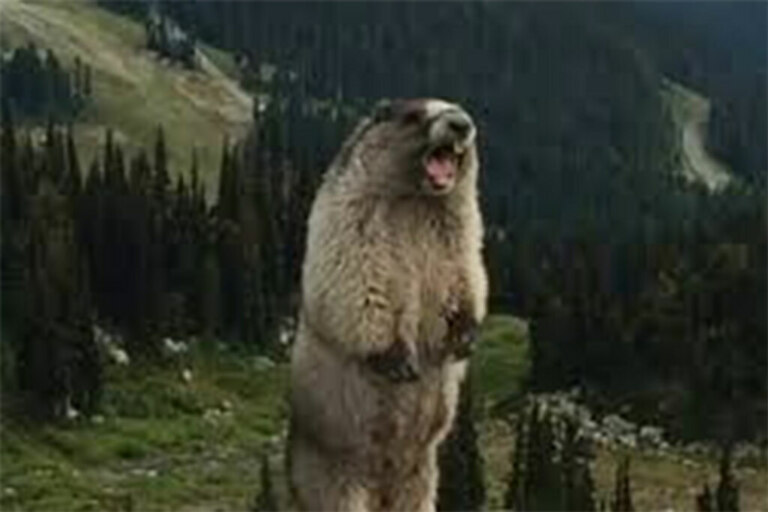
The original clip was filmed in 2015 on Blackcomb Mountain near Whistler, Canada. The company Lone Goat Soap Co. posted it on Instagram, then uploaded it to YouTube on July 25. In the description, the creators specified the filming location and identified the animal as a marmot; later retellings sometimes mistakenly call it a prairie dog or a bobak marmot. In the footage, the animal stands vertically on a railing and lets out a short, high-pitched shriek.
Almost immediately, the sound started getting reworked: a human scream, music, and other audio tracks were layered over the footage. It was precisely this kind of editing that made the original clip suitable for remixes. A still frame survived too: the animal appears frozen with its mouth open against a backdrop of dark forest. Without sound, the recognizable pose remains, and the sharpness of the reaction gets filled in by the viewer.
Visual joke and sound joke
The video has two versions of its humor. In the original, what's funny is the unexpected loudness of a real animal and its almost human-like upright stance. In remixes, the humor shifts into the editing itself: a calm landscape suddenly gets torn apart by someone else's scream or a dramatic song. So it matters which version is being discussed. An illustration without a caption conveys a general shriek, but doesn't let you claim you're hearing this particular marmot's original voice.
The frame can signal an emotional outburst, a sudden realization, or a reaction to an event too big for a calm response. It's especially effective after a short setup line: the viewer has time to picture an ordinary situation, then gets hit with an image of maximum volume. If the explanation is longer than the joke itself, the contrast disappears.
Its recognizability rests on a simple composition: the animal is set apart from the background and raised above a railing, and the open mouth lines up with the expected sound. Even a tiny preview thumbnail hints at a scream. So the template doesn't need elaborate editing: a single caption can turn the pose into a ready-made climax.
Original captions for "Screaming marmot"
"Me: going to bed early tonight. Also me at 2:17 AM: remembered I never replied to that email." The shriek signals sudden panic, and the precise time makes the situation recognizable.
"When at a meeting someone asks who wants to present first." The frame turns an inner urge to disappear into a loud physical response; it's self-deprecation, not an accusation against the meeting host.
"Opened the headphone box and saw there was only one earbud inside." Here the caption sets up a small but unexpected letdown. The marmot shows how disproportionately intense it feels in that moment.
Choosing a format
For the loudest effect, a short video with audio works best, especially when the sudden shift from silence to a scream matters. A still image is handy in chats and works better paired with a caption that builds up to the emotional snap. It's worth avoiding calling any remix sound "the marmot's scream": many versions deliberately swap in or process a different audio track.
The meme suits hyperbolic reactions in casual conversation: a deadline suddenly got closer, a line is moving too slowly, an app froze again. It's less suited to messages about a real tragedy or someone else's serious distress. In that case, the comic shriek can come across as trivializing the situation.