What's in the frame and how to read it
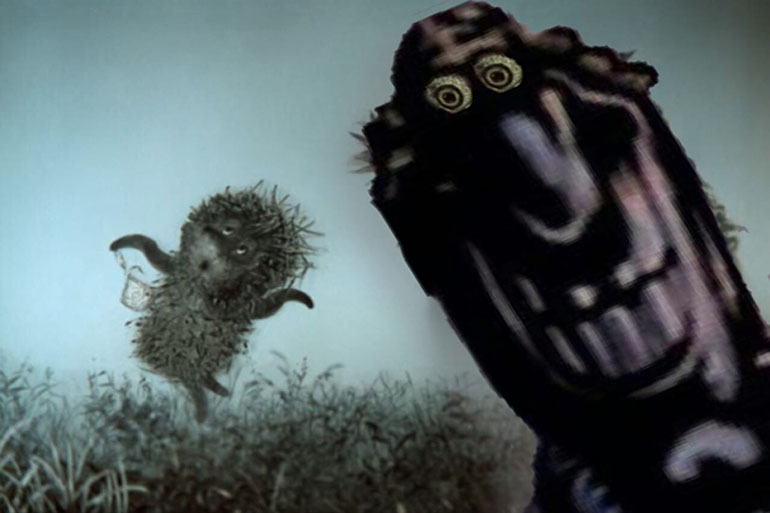
The image is a composite. On the left, in thick fog on the grass, a small dark figure is visible, resembling the hero of Yuri Norstein's Hedgehog in the Fog (1975, Soyuzmultfilm, screenplay by Sergei Kozlov). On the right, in close-up, is a dark, almost pitch-black face with round pale eyes and a wide grin.
The image labels the figure on the right as a "dark" version of Dr. Livesey, but the frame alone doesn't let you confidently say who it actually is. So treat it as an example of the genre: a familiar face distorted into something eerie.
An animated film from Kyiv
Treasure Island is a Soviet adaptation of Robert Louis Stevenson's novel. It was made by director David Cherkassky at the Kyivnauchfilm studio, premiering in 1988. The film has two parts and blends hand-drawn animation, musical numbers, and live-action inserts.
Dr. Livesey in it is an optimistic, good-humored, self-assured doctor, voiced by Yevgeny Paperny. It's precisely that confidence that made the character meme-worthy: he carries himself as though he knows the answer to any question.
Russian-speaking audiences also know his line about rum and death: viewers read it as the doctor advising people to treat the two words as synonyms. The phrase became its own separate springboard for captions, independent of the frame itself.
From a VK community to the "dark" version
The character got his mass following thanks to VKontakte: a community posting Treasure Island memes for every occasion appeared on December 10, 2018, and became the main engine of his popularity. By 2021, Livesey had become established as an image of the "chad" — someone who laughs triumphantly at everything.
In the summer of 2021, a "dark" version also emerged: frames from the film were reworked into something frightening, and in August the format merged with the meme about a traumatized Mr. Incredible. A separate wave hit in 2022, when a clip of Livesey's walk went viral on English-language social media.
Why the light and dark sides pair so well
The joke works on a "before and after" principle. The bright doctor shows a perfect state — energy, triumph, composure. The dark one is the same face, but with the light drained out of it. Between the two frames sits the implied story of someone whose life went wrong.
The contrast is sharpened by how good-natured the original is. The less threatening the source material, the stronger the effect of the distortion.
It's also worth keeping the timeline in mind: the film came out in 1988, the community appeared in 2018, the "dark" format took shape in 2021, and the walking clip went global in 2022. Decades separate these points, so the meme isn't an "old joke" — it grew out of a new generation rediscovering an old animated film.
Caption examples
Bright version: "Me on Wednesday, after making a plan for the week." Dark version: "Me on Friday, opening that plan." The pair is simple, but the reversal is obvious.
"Heading to a workout in a great mood / forty minutes into looking for parking" — two states on one face, with the viewer filling in the road between them.
"Livesey at the start of his vacation and Livesey the day before going back to work" — a joke about how fast time flies that needs no explanation.
For the dark version, captions about small anxieties work well: "Phone showed 1%." The key is not to overload the text, or the fear turns into a wordy retelling.