what is actually shown
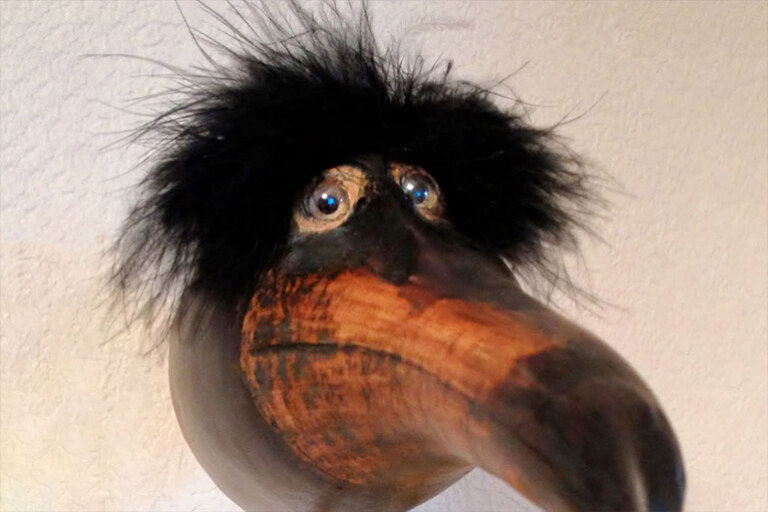
This is a close-up of a bird's head. On top is a black crest of sparse, stiff feathers, with individual strands sticking out to the sides. Below sit two small pale eyes with blue highlights. The beak is huge, orange-brown, blotchy and worn, curving down and to the right, and longer than the head itself. The body is dark gray, matte, and rough-textured. The background is a light, textured wall; the shot is clearly an amateur, home setup.
An important clarification: this is not taxidermy in the museum sense. The artist works with dried decorative gourds, which are carved and painted, so the head and beak are parts of a single crafted piece, not separate objects.
who made the bird, and why it waited ten years
The figure's creator is the American artist Jen Norphen. She makes crafts out of decorative gourds: big-eyed mosquitoes, dragonflies, geese with painted-on lips, a melancholy rhinoceros.
The bird appeared long before its fame. In 2015 the artist posted a photo of her gourd crows, and in 2017 she put a photo on Pinterest with the caption about "the pet raven everyone should have." That exact raven became the prototype for the future meme.
For years the post drew almost no interest. The work had no name called "Skebob" back then: that was coined later, and not by the artist.
how the bird got its name
In March 2024 a musician posted a track on SoundCloud titled "4Penoplastyr Klubnyak 2008," using as its cover a photo of the gourd crow captioned "Skebob." This is the earliest known use of the word. Different retellings spell the author's username differently, so it shouldn't be taken as settled.
What the word itself means is unknown. There are three theories: a garbled version of "skibob" — a sled-like device for riding downhill; just a string of funny-sounding syllables, like "tralalero"; a nod to SpongeBob based on the sound. None is confirmed, and it's possible the word has no meaning at all.
how a static craft piece became the hero of video clips
The first Skebob memes appeared in Russian-language social media in May 2025, with the peak coming in July. At first these were topical jokes, which were then pushed aside by AI-generated clips.
The pattern is simple: the first second shows the original photo, then the crow "comes alive" and something unexpected happens. The clips are generated with Hailuo AI from MiniMax — a picture is uploaded and a text prompt describes what should happen next; a watermark from the service is often still visible on the video.
Almost always the track "Buildin Shake" by Venz X Haitch plays in the background, though it sometimes gets swapped for anything else. The storylines are similar in spirit: Skebob steals something and runs from the police, fights grandmothers, falls into depression, dances, meets another Skebob, flies into space. Later, bloggers and online marketplaces picked up the character too.
why this particular crow works as a joke
The main device is the contrast between a clumsy handmade figure and smooth, confident animation. The object is obviously handcrafted, yet it moves and holds itself in frame like an actor.
The second device is the impenetrable face. The bird looks equally scared and pleased, so any emotion can be projected onto it: offense, insolence, exhaustion.
The third is the structure itself: the still frame cuts off, the expectation breaks, and that alone is funny. On top of that, the nonsensical name lowers the bar further: the viewer doesn't need to understand anything to laugh.
example captions and how to use the template
The examples below are not quotes from other people's clips but illustrations of how to use the template.
"Skebob applies for a job" — funny because a serious office scenario is played out by a gourd crow. "Skebob explains why he's late" — this works because of the unreadable face: you can't tell from it whether he's lying or not. "Skebob finds out tomorrow is Monday" — the viewer, not the picture, supplies the emotion. "Skebob versus the robot vacuum" — pits the handmade craft piece against real technology.
A tip for using it: keep the first frame clean and still, and give the action real consequences — the crow should break something, steal something, or lose something. Don't explain the joke in the caption, and don't superimpose real people's faces.