What’s in the frame
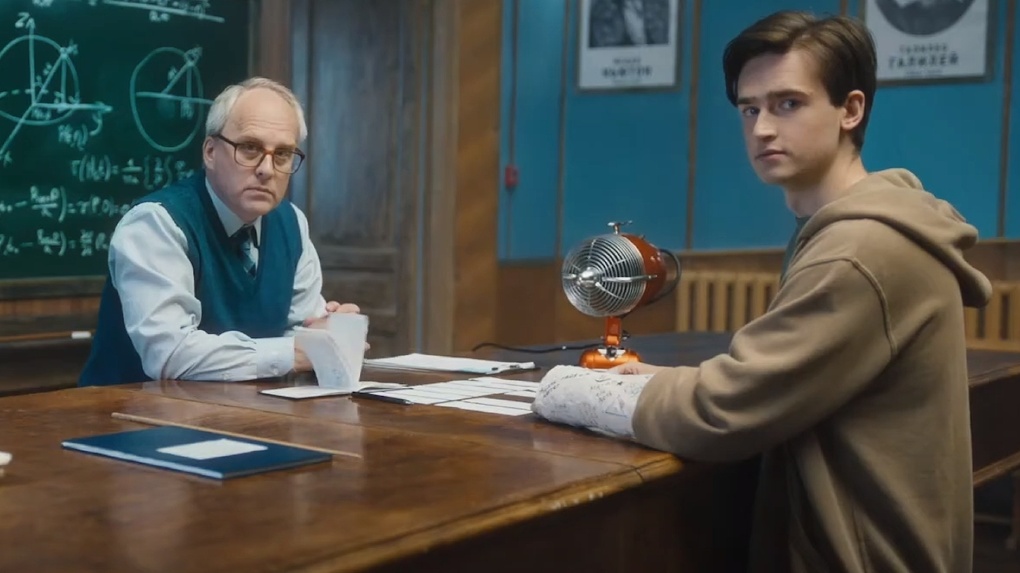
An old-fashioned lecture hall or study. On the left, behind a long wooden table, sits an older man with gray hair and glasses, in a dark green vest over a shirt and tie. Behind him is a board with formulas and circle diagrams. On the right is a young man in a beige hooded sweatshirt: he has turned his head straight toward the camera. The older man’s gaze is also directed at the viewer. On the table are papers, rolled sheets, a blue folder, and an orange desk fan; on the wall hang framed portraits with captions.
The key to the composition is the simultaneous gaze of both characters: they seem to have just finished talking and turned toward whoever is watching. The calm faces and stern setting make the joke drier: nobody smiles, and the accusation sounds like a scientific conclusion.
How the joke is built
The format has three steps. First one character delivers the lead-in, “They say every third person...,” and names some quirk or habit. Then the second nods or asks for clarification. Finally both look into the camera: if it isn’t one of them, then it must be you.
The secret is that the “statistic” is most often made up and harmless. The author of the joke doesn’t accuse the viewer but pretends to have just counted: you are exactly in that third.
From the early version to the 2020 ad
The format is older than the ad. According to some accounts, three-panel pictures of this kind were circulating on Reddit as early as May 2014, but the original source and the exact date differ between retellings, so who first came up with the device cannot be said.
In 2020 the mobile operator Yota released a commercial. In it, two characters discuss how every third person overpays for an unused part of their plan, and then one says he uses Yota, while both look into the camera. This ad is connected to the meme’s second life in Russia. Whether the frame in the picture matches a frame from the ad is not known.
Caption examples
“They say every third person opens the fridge just to check whether something new has appeared.” Nearly everyone knows this action, and the look into the camera turns into a good-natured “busted.”
“They say every third person sets an alarm five minutes before they need to get up and then snoozes it five more times.” The joke jabs at the reader’s everyday weakness.
“They say every third person reads the comments before the article.” The caption targets a habit of the audience itself.
“They say every third person pays for a subscription they don’t use.” This is an almost literal echo of the ad’s plot.
Where the meme appears
It also works in conversation: just say “they say every third person...” and hold a pause, and the listener understands where it is going.
The template fits personal habits, professional quirks, and hobbies. For brands it is handy because it lets them start with the audience’s “problem” and lead up to their own offer, as the operator’s ad did.
When making your own version, avoid “statistics” about illnesses and vulnerable groups: the point of the joke is light, harmless recognition, not a jab.