What the photo shows
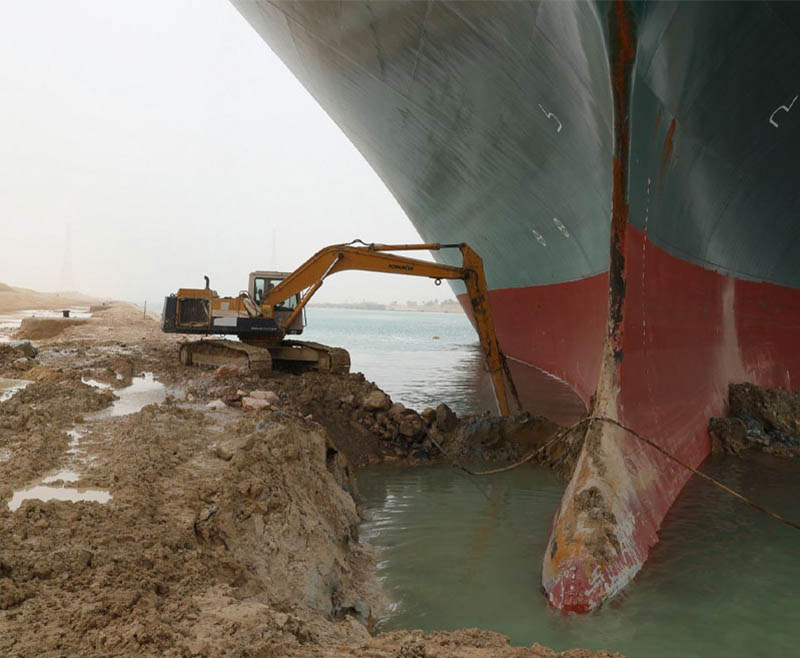
The right and upper part of the frame is taken up by the ship's side: a dark green hull above and a red underwater section below, with rust streaks and a thick rope at the waterline. On the shore to the left stands a small yellow-orange tracked excavator with a long boom. The bucket is lowered to the water's edge right by the ship's bow. The shore is churned up and rutted, with puddles in the ruts, and a murky sand haze hangs over everything.
The photo works without a caption because scale does everything. A machine that usually looks imposing seems like a toy against the steel hull, and the person in the cab is barely visible.
Timeline: six days in the Suez Canal
The container ship Ever Given, operated by the Taiwanese company Evergreen Marine, ran aground in the Suez Canal on 23 March 2021. Reports at the time cited strong wind and a sandstorm that turned the vessel sideways; later the circumstances were discussed separately, and publications do not agree on a single explanation of the cause. The ship is about 400 meters long, so it blocked the canal almost entirely.
The canal links the Mediterranean with the Red Sea and carries a notable share of world maritime trade, so the halt quickly became international news. Estimates of daily losses vary across publications, on the order of billions of dollars a day, and precise figures should be treated with caution. Tugboats and earth-moving equipment were brought in for the rescue operation, and the ship was refloated on 29 March.
How the excavator became a hero of jokes
Photos from the site spread across social media in the first days. Among them this one stood out: the excavator, seemingly trying to clear the shore beneath the giant hull. Viewers saw in it a ready-made image of any unequal struggle.
Other lines of jokes emerged in parallel: the ship was “humanized”, parody accounts were created in the voices of the ship and the excavator driver, and fan pictures were drawn. But the photo with the small machine proved the most portable, since it only takes captioning two parts of the frame.
Caption examples and why they work
Excavator: “Me with a plan for the day.” Ship: “A sudden urgent task from my boss.” The joke rests on the size difference: the plan looks tiny next to the force majeure.
Excavator: “The one person in the group chat trying to get everyone to make peace.” Ship: “A forty-message argument.” It is funny because the effort is noble and the result is clear in advance.
Excavator: “My to-do list.” Ship: “My to-do list after vacation.” The caption works through recognition: everyone has seen their inbox after a vacation.
Excavator: “Me explaining to my grandmother how to use an app.” Ship: “The app.” The assignment of roles in such captions matters more than the text: the viewer finishes the thought themselves.
Usage tips
Caption both halves: the small one on the left, the huge one on the right. If the caption sits only on the excavator, the joke loses half its force, because the contrast is what creates the meaning.
Keep in mind that a real accident with large economic consequences lies behind the frame. That is why jokes about everyday scale are best, rather than jokes about the people involved: the excavator driver in the photo was simply doing his job, and there is no need to push the joke into mockery of him. A sign of a good caption is that it is funny even to people who have themselves once struggled with an impossible task.