What is visible in the photo
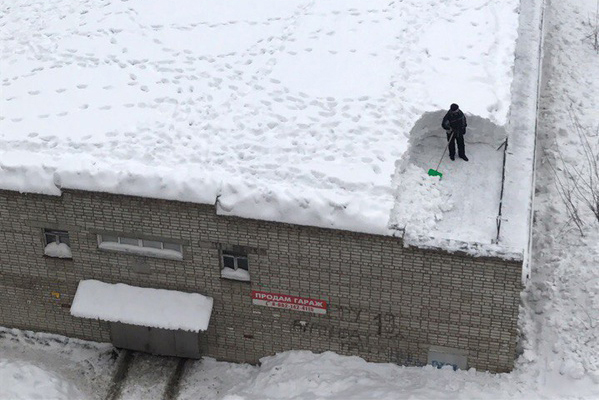
The photo is taken from above, and that is the defining feature of the frame: the roof fills almost the entire upper part of the image, and the building below looks squat. The snow lies in a thick layer, its surface marked with footprints, as if someone had walked over it many times. Along the edge of the roof the snow hangs down in a white overhang.
On the right side of the frame stands a man in a dark jacket holding a green shovel. He has cleared a small section right at the edge, and around that section the snow rises in a high ridge. The rest of the roof is white and untouched. A sign on the brick wall reads “ПРОДАМ ГАРАЖ” (“GARAGE FOR SALE”), and above the entrance to the building lies another snowy overhang. These details suggest an ordinary working moment rather than a staged shot.
Where the photo came from
The author of the photo, the place of shooting and the date are unknown: the first signed and dated publication of the frame is not known. For that reason neither the city nor the specific building can be named, since any such detail would be a guess. It is also not worth trusting claims about the number of floors: from a single overhead angle, the number of stories cannot be determined.
The sign “ПРОДАМ ГАРАЖ” on the wall suggests that this is an outbuilding, possibly a garage unit, but even that is only a guess based on the signage. The year the image first appeared online is also not known precisely, so it cannot be told as an event with a history.
The scene itself has no famous backstory. It is an ordinary winter picture that became a template thanks to the contrast between the scale of the task and one person with a shovel.
Why the frame is funny
The joke rests on proportion. The roof is huge, the man is small, and the completed work is a narrow strip. The viewer quickly calculates that if one cigarette break's worth of effort cleared that much, the whole roof would take the entire season. It is this sense of endlessness that makes the frame convenient for irony.
There is a second layer: the frame looks calm. No one is falling, no one is cursing, and no one looks broken. The man keeps working, and this composure pushes the captions toward a dry, almost businesslike tone. The joke sounds like a process report, and that is its main strength.
Examples of captions and how they work
“Cleared the path. The rest in spring.” The caption places the frame in time: the warm season becomes a deadline that the work will not reach. It is funny because “in spring” sounds like a natural resolution rather than a promise.
“Progress: one strip out of an entire roof.” The joke relies on the language of reports. A precise statement about the share of work completed turns a modest result into a statistic, and the gap between the dry tone and the picture creates the laugh.
“The boss asked how things were going on the roof.” This example moves the frame into an office setting. The expectation of an answer like “everything is fine” collides with the obvious amount of snow, and the viewer supplies the line for themselves.
“Winter marathon: the finish line is still not in sight.” The caption makes the task sporting and stretches it over time. The uncertainty about the deadline strengthens the effect: it is unclear when the work will end, so every strip looks important.
How to use this template
The frame suits conversations about drawn-out tasks that seem hopeless but are still moving. It is better to aim the irony at the task rather than the person: he is working in the photo, and the joke lands best when the viewer laughs at the scale of the job rather than at the worker.
Captions that scold, such as “he's slacking,” do not fit the frame, because the picture shows the opposite. What works is a plain statement: little has been done, and the task is enormous. One short phrase is usually stronger than a long description, so it is best to choose one and not overload it with details.