The joke came out of a yard comment
In February 2018, Mikhail Kozyrev suggested on Facebook a joking way to speed up snow removal: write the surname of Alexei Navalny on a snowdrift. The idea rested on the notion that a political inscription is cleared faster than an ordinary utilities problem. The snow became a carrier of a message that supposedly changed the urgency of the services' work.
On February 10, Muscovite Tatiana Grigorieva told a community of the Nagorny district about her own experience. She applied the surname in green substance to snow banks and an icy sidewalk. At first, according to her reports, the snow was dug up so that the words disappeared from view. Then new posts appeared about further clearing. The story spread through the news and social networks.
Later, similar reports came from other places, including Tomsk. Users saw in this chain of events confirmation of a successful joke and began inventing new uses for it. However, the account of one yard does not establish a general order of work for utility crews or their political motives. For the meme, what mattered was another thing: the visible shift from an ordinary complaint to an allegedly all-powerful short word.
The surname takes up two lines
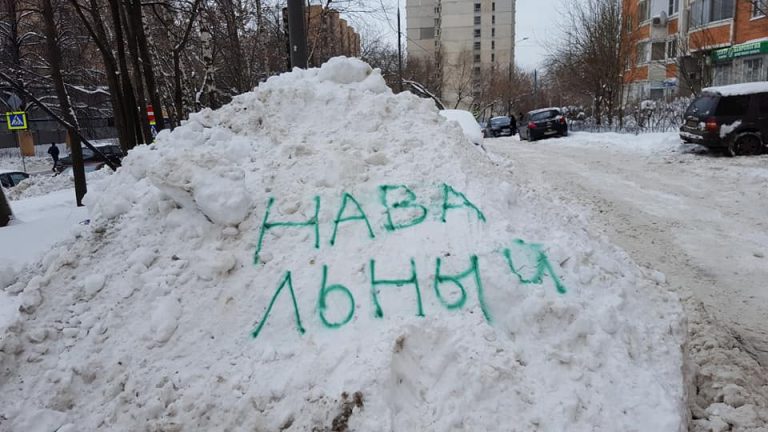
The photograph shows a large snow pile standing near residential buildings. On the front slope, the surname is written in green letters, broken across two lines. Trees, cars, and street signs are visible behind. The urban background makes the image resemble a documentary record of a yard problem, and the bright color makes the inscription stand out at once against the white snow.
This is a single frame taken before the snow pile disappears. There are no janitors, cleaning machine, or comparison with a cleared spot in it. Therefore the photograph itself shows the intervention of the inscription's author but not its result. In the meme story it serves as the beginning of an imagined sequence: there was a usual nuisance, a word appeared on it, and after that the reader expects a swift change.
A political word becomes a household incantation
The mechanism is built on an alleged difference in priorities. An ordinary snowdrift can remain unnoticed for a long time, while a politically prominent inscription supposedly gets immediate attention. The joke does not offer a new means of cleaning: it attributes to a familiar name the power to switch attitudes toward an old task. The absurdity arises because the physical properties of snow have not changed at all.
In the following variants the surname was transferred to broken roads, entrances, and already quite personal difficulties. The realistic basis gradually gave way to a fantastic universal solution. Services that could clear snow or paint over a wall turned into imaginary performers of any wish. Political satire merged with the common dream that an unpleasant task might disappear without effort.
For this remake, the difference between a serious problem and the simplicity of the proposed action is especially expressive. A long complaint, a complicated request, or accumulated work is replaced by a single inscription. The further the task is from the real duties of utility workers, the more obvious the fantastic nature of the promise becomes. The meme keeps the confident tone of practical advice even where its execution could obviously not produce the needed result.
A service that carries out incredible requests
In an invented version, a student writes the surname on a folder with an unfinished coursework and expects it to be fully formatted by morning. Snow removal turns into editorial work. The comic leap happens precisely in the choice of task: the name that supposedly attracted janitors must now also find the author of the text.
Another example moves the inscription onto a box of tangled charging cables. The owner expects that the mysterious urgent service will untangle everything itself and sign every cable. Household disorder receives a solemn political design, and the person tries to pass off a wish to avoid boring work as ingenuity.
In a third sketch, a company writes the surname next to a difficult puzzle in a board game. The participants hope it will be removed from the task at once and let them move on. Here the literal disappearance of the obstacle matters more than a real solution. All these fictional variants continue one logic: a small word promises an enormous service, and the mismatch between expectation and action remains the main source of satire.