The song and the meme wave
A Stas Ekstaz song had already been circulating online in 2017. In autumn 2018, a similar linguistic construction began to appear on photographs of reptiles and in short videos. These are different stages: the track was already on the internet when its wording became a separate part of meme images.
In the song the phrase is sung in the performer's voice; on the pictures, the animal takes it over, as if introducing itself to the viewer. Knowing the music adds an extra intonation, but the text version is understandable without listening. What matters here is the shift from a human voice to a literal reptile: instead of telling a story about a hero, the photograph presents him directly to the reader.
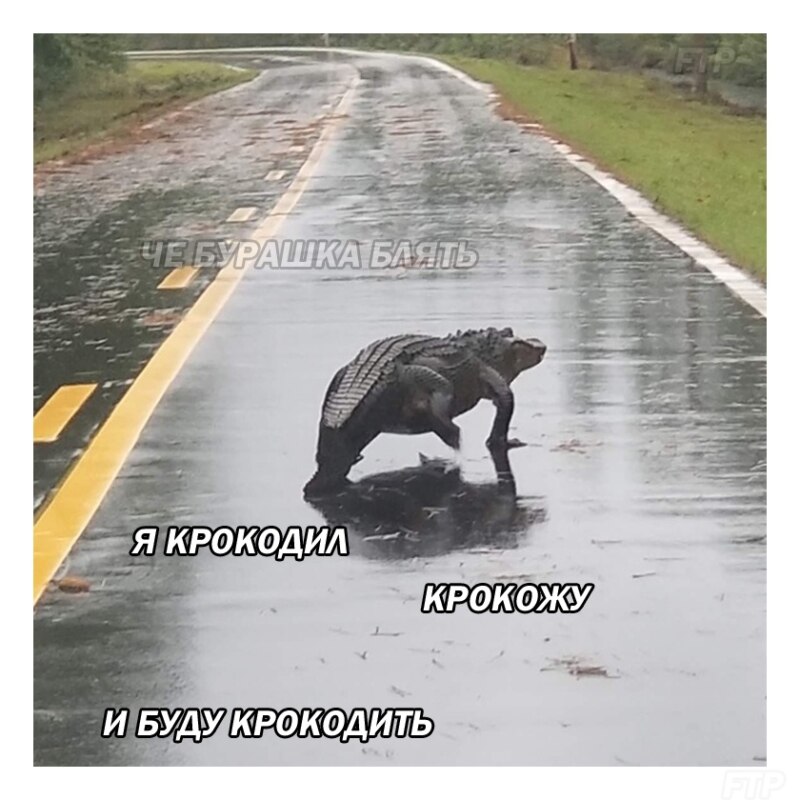
The animal on a wet road
In the photo, the crocodilian stands on a wet road, resting on its legs. Around it are reflections, yellow road markings and a green verge. The caption is split into three parts: the first sits under the animal on the left, the next lower on the right, and the last takes the bottom edge. The eye moves through these lines gradually, like a short announcement with growing confidence.
The everyday road setting heightens the absurdity of a solemn self-introduction. The animal looks like an unusual participant in a familiar space, and the words give it its own agenda. The authorship of the road photo and any link to the song's performer are not established: this image works as a standalone illustration of the formula, not as a documented frame from a music video.
The animal becomes an action
The formula begins with a noun, then turns it into an invented verb and promises a continuation in the future tense. The animal's name seems to acquire a new meaning: being one means also performing a special activity. The sequence resembles a confident motto, although the action itself is never explained and needs no definition.
It is exactly this emptiness that lets the construction be applied to other creatures. The result is a short way to declare a character or mood using deliberately wrong word formation. In a still picture, the reader reconstructs the rhythm of the three parts; in a video, voice, music and repeated movement can set it. The road version remains a visual self-presentation, while a musical remake can turn into a scene with its own sound-based punchline.
Invented captions
These examples were invented for this article. Heading: “Today I'm a turtle, I turtle, and I will keep turtling.” It carries the word-formation mechanism over to another animal, turning its name into an activity and a promise to continue.
For a photo of a crocodilian at a bus stop, a fitting caption would be: “Stepped out for a minute, already crocodiling.” An ordinary wait becomes a special job simply because the character talks about it with complete conviction.
Another invented variant for the road scene: “Route check: the crocodilian is already in position.” It gives the character the role of an inspector and plays on the seriousness of an everyday roadside setting.