What's shown
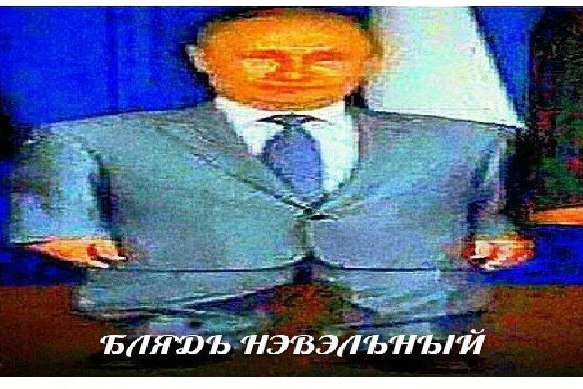
The picture shows a stretched and distorted photograph of a man in a light gray suit with a blue tie. His face has an orange tint, the figure visually smears, and the edge of the frame is shifted. At the bottom of the image, bold light-colored letters with a dark outline spell out "BLYAD' NAVALNY." According to the catalog's attribution, the man in the photo is Vladimir Putin.
The low quality and distortion are typical of many early internet images that were repeatedly re-saved and re-encoded. This visual sloppiness works as part of the joke: the meme looks crude and unofficial, matching its casual, mocking tone.
Origin
The meme's author and exact appearance date haven't been established. The meme dates to 2017, when Navalny was especially prominent in the Russian media landscape because of his political activities and anti-corruption investigations. The original source of the image is not known.
The caption is built on wordplay. The first part, "blyad'," is an emotional interjection used to express irritation and annoyance. The second part is Navalny's surname, which the combination turns into an object of blame. The result is a formula that sounds like both a curse and a joke about the politician at once.
The meme spread through forums, community pages, and messengers, where pictures like this got forwarded quickly without crediting an author. Over time it became recognizable by its distinctive distorted photo and caption, and even without the text it was clear what it meant.
Wordplay and meaning
The catalog's description interprets the meme as an image of the urge to dump one's problems and mistakes on others and to make them the ones to blame for everything. The meaning is built on an everyday situation: a person fails at a task, breaks something, or loses an argument, and looks for someone to blame. In such cases the formula "blyad' Navalny" is used as an ironic explanation for why everything went wrong.
The joke works on the level of the phrase's internal logic: the caption turns a complicated political figure into a convenient scapegoat image. The meme doesn't contain any developed argument and doesn't explain political positions, it relies on an ironic juxtaposition.
Political context
The meme belongs to the category of political humor, where public politicians become objects of parody. Both figures are public figures, and their images are regularly used in internet culture, including in caricatures, memes, and parodies. This practice is widespread, which is why the picture is perceived as part of the general stream of political satire.
The political context also matters for understanding how such material circulated. Attitudes toward this kind of content in Russia have shifted over different periods: in 2025, for example, a court in Omsk banned links to memes comparing Putin to Hitler. This example doesn't relate directly to this particular picture, but it shows that political memes remain within the scope of legal disputes.
Usage
The formula most often appears in comments, chat replies, and reaction captions. A typical situation is when someone explains their own failure by external circumstances, and the other person jokingly replies "blyad' Navalny," hinting at an excessive tendency to look for someone to blame.
Thanks to its short, memorable form, the meme transfers easily to other situations. It works both as a joke and as self-deprecating humor, so it's used even by people who have nothing to do with politics. Its relevance, however, depends on the political context, and it has sounded different in different periods.