Colorful letters on a crumpled sheet
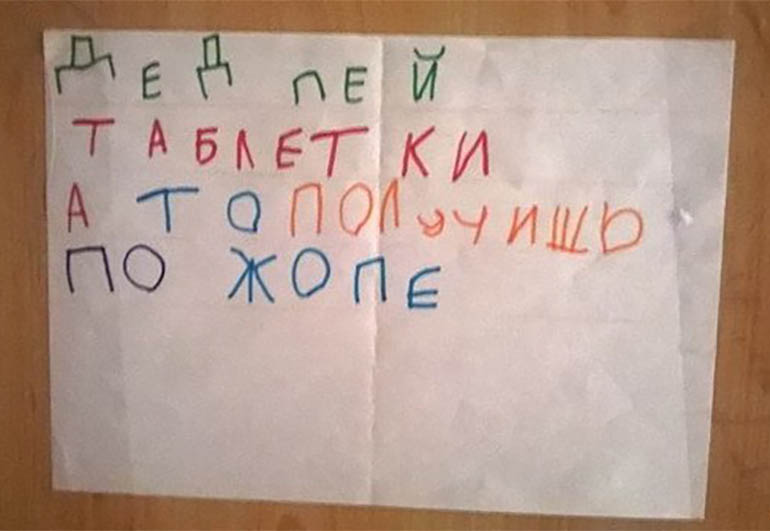
The photo shows a light-colored sheet of paper on a wooden surface, with visible fold marks. The message is written in print letters of different colors — green, red, orange, and blue — uneven and large, across four lines: "Grandpa take," "your pills," "or you'll get it," "in the..." followed by a strong word at the end. The letters in the word "get" are especially crooked, which emphasizes the childlike handwriting.
The image alone can't tell us who wrote the note, how old they were, or who it was addressed to. But the childish handwriting is visible, and it's exactly what gives the text its comic sternness, since the threat sounds grown-up while the letters are drawn with exaggerated care.
What's known about its origin
According to one version, the message appeared on the Russian-language internet on March 1, 2015, on a major aggregator site. The author of the note, their age, and the circumstances of the photo haven't been established. Elsewhere you can find posts captioned "Grandpa, take your pills," but they relate to different stories and don't prove the origin of this particular photo.
So the only thing that can be said reliably is this: the photo of the note has existed since the mid-2010s, the author's identity is unknown, and widespread recognition came later.
From 'ok, boomer' to political posters
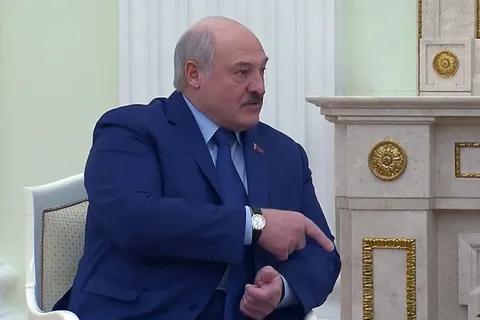
At first the phrase worked as an equivalent of the English "ok, boomer": it was used to respond to older people grumbling, or to behavior seen as "old-mannish." Later, according to reports, in 2019–2020, it came to be associated with criticism of politicians, primarily Vladimir Putin and Alexander Lukashenko, especially during the 2020 protests in Belarus.
It's worth remembering: a caption aimed at a politician expresses someone's opinion, not a fact about his health. The phrase itself remains a way to bluntly and briefly say "you're being unreasonable."
How the comedy of the threat works
The humor rests on a reversal of roles. Normally it's adults who look after children's health, but here the roles are swapped: a child is sternly looking after an elder. The threat of a smack adds a domestic touch — it can't be taken seriously, yet it sounds convincing.
It's exactly this mild aggressiveness that makes the phrase suitable as a response to almost anything: strange claims, outdated views, stubbornness. Its meaning is "you're being unreasonable, go get treated."
Invented captions
"Grandpa reads the comments under a news article. His granddaughter is on standby." The caption explains that behind the stern note lies real concern.
"A message for everyone arguing online at three in the morning." Here the phrase is redirected at adults.
"My cat, when I get up without an alarm." The caption changes the recipient, and the threat becomes endearing.
"My attitude toward someone else's confidence on a topic they know nothing about." This version makes the recipient an opponent in an argument.
When it's better not to use it
The phrase can easily turn into mockery of old age, and that's not always appropriate: an elderly person simply voicing an opinion doesn't deserve to be told to "take their pills." It's better to apply the meme to situations rather than to specific people.
If you use the image in a political context, remember that its meaning has shifted over the years, and in some circumstances it's read as a pointed statement.