What is in the picture
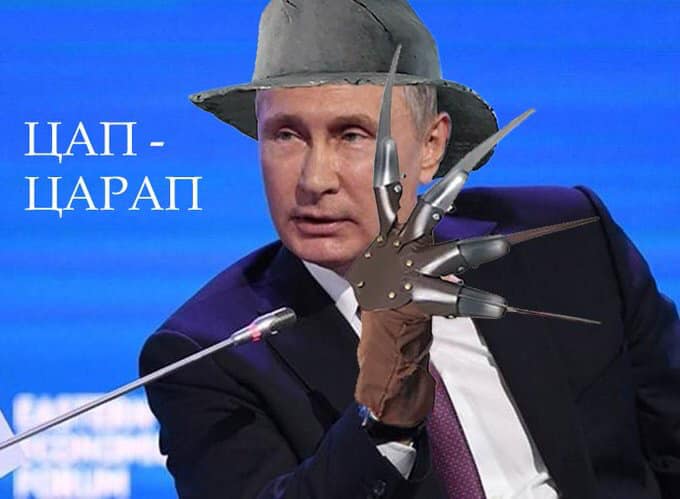
This is a photomontage. In the original photo, a man in a dark suit sits at a table with a microphone and speaks, with a blue background in front of him. At the bottom left, a fragment of the English inscription “Eastern Economic Forum” is visible in the background, meaning the photo was taken at a different event, not the one where the phrase was said. A gray wide-brimmed hat and a glove with long metal blades on the fingers have been added to him: these are the trademark props of Freddy Krueger from horror films.
On the left of the picture, the words “ЦАП-ЦАРАП” are written in white letters in two rows. The montage turns the word into the sound of claws scraping glass: the bladed fingers seem to scratch the air. The whole picture is a play on words, not a documentary frame.
What was actually said
According to media reports, on November 21, 2019, at the VTB Capital investment forum “Russia Calls!” Putin criticized shale extraction technologies: he called them barbaric and said they harm the environment. According to the same reports, he jokingly suggested waiting until Americans spend money on new technologies and then buying them cheaply. The phrase “tsap-tsarap” was used to denote a quick and profitable appropriation of someone else’s result.
The exact wording and its precise order differ between retellings, so what is given here is the general sense of what was said rather than a verbatim quote. Sources do not confirm any gestures or motives on the part of the speaker.
Why the phrase caught on
A word from the children’s and colloquial lexicon was spoken at a serious economic event, where dry formulations are the norm. This gap worked like a lucky find: people want to repeat it. The word is short and catchy, easily fits into any sentence, and so quickly entered everyday use.
The montage with Freddy Krueger is built on the sound resemblance between “tsarap” and “tsarapat” (to scratch): if the phrase is about tsap-tsarap, then the fingers must be clawed. Such coincidences make memes durable, because the picture explains the word without words.
Caption examples
“I waited until my colleague did all the work, and tsap-tsarap—the report is mine” — a joking description of appropriating someone else’s work in the office. Here the word denotes a quick, grabbing action.
“Sale over? Tsap-tsarap, I got the last pack” — an everyday example of a successful purchase.
“The cat and the last piece of sausage: tsap-tsarap” — the most direct reading of the word, which the picture itself suggests.
“Waited for the sale and tsap-tsarap” — the word as a symbol of calculated cunning.
How to use the template
The meme is handy wherever you need to show a quick appropriation or a deft move. Neutral everyday captions work best: a meme about claws and a hat does not require knowing the context of the speech. If you refer to a real quote, do so carefully and do not attribute to the speaker something they did not say.
Keep in mind that the picture has been edited: it is a parodic collage, not a documentary photograph, and it should be used as a joke, not as evidence.
If you use the picture not for the montage but for the quote, try to separate fact from joke: the word was spoken as a figurative expression about buying ready-made technologies, not as an exact description of policy. That way the caption stays funny without misleading the reader about what was actually said.