A phone receiver among birch trees
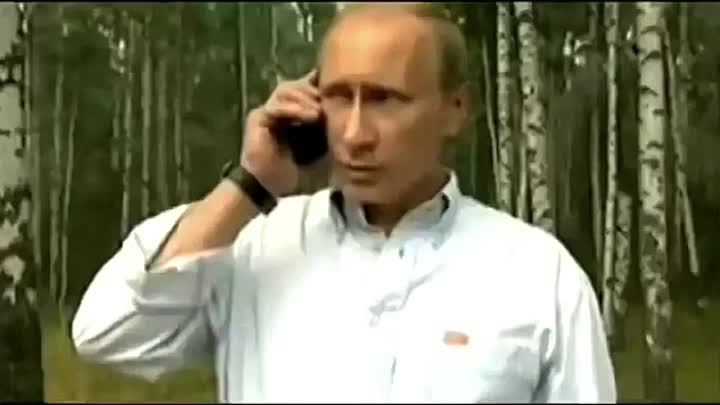
The frame shows a man standing in a forest, with white birch trunks and green leaves around him. He wears a light shirt with the collar unbuttoned and a dark watch on his wrist, and he presses the phone to his ear with his right hand. His face is turned almost straight toward the camera, his gaze is focused, and his brows are slightly furrowed, like someone listening to unpleasant news.
This is a still from a video. Where exactly the frame was taken, and who first captioned it with the money phrase, has not been reliably established. Apart from the quote itself, the picture works as a convenient illustration: the forest, the phone and the serious face convey the feeling of a long, awkward conversation.
A prank about subsistence-minimum capital
The phrase comes from an audio recording of a phone prank. The caller introduces himself as Mikhal Palych Terentyev and repeatedly asks an elderly listener how things are going with money, mentioning investments in “subsistence-minimum capital.” The recording itself, according to accounts, was made around 2004–2006, and the earliest known upload to a video hosting site is dated September 2008.
In 2020, a person who called himself the author of the prank said he had recorded it as a teenager and had long since given up the hobby. His words cannot be verified, so the name and details remain unconfirmed: it is only known that the caller was a young prankster, and the listener simply replied in confusion and politeness.
Why the meme took off in 2020
The recording gained a new wave of popularity in 2020. At the end of that year it began to be overlaid on a published phone conversation between Alexei Navalny and a man he believed was involved in his poisoning. The comparison sounded like a prank joke, the old prank suddenly returned to feeds, and search queries for it hit a record high.
The format itself stood out: ordinary small talk that needs no explanation. The question about money seems normal, but the caller has no clear goal, and the conversation develops like an absurd interrogation. That is exactly why the phrase is easy to transfer to any situation where someone politely presses on a sore spot.
Caption examples
Three invented variants show different roles for the picture.
“So how are things with money?” — a caption under a photo of a person checking their card balance three days before payday. The phrase sounds like a line from an inner monologue.
“The bank that calls at nine in the evening: so how are things with money?” An everyday situation where a question to the “caller” becomes intrusive.
“A friend I lent five bucks to back in 2019: hi! how's it going, how are you — and only after five minutes of small talk — ...so how are things with money?” The phrase comes back at the very end of the conversation, just as in the original prank, where the conversation approached money from a distance.
How to use this frame
The picture works as a reaction to a message where the other person is too insistent about someone's finances or pretends they are just asking how things are going. The caption is best kept short and in question form: a long text would ruin the effect of the unexpected call.
Do not put real phone numbers, debtors' names, or any personal data of private individuals into the caption. For political jokes based on the frame, remember that the photo proves nothing about the conversation or the man's finances, and the caption expresses the joke author's opinion. The safest and funniest uses concern salaries, loans, debts and savings, where everyone recognizes their own situation.