Press conference in Astana, September 1999
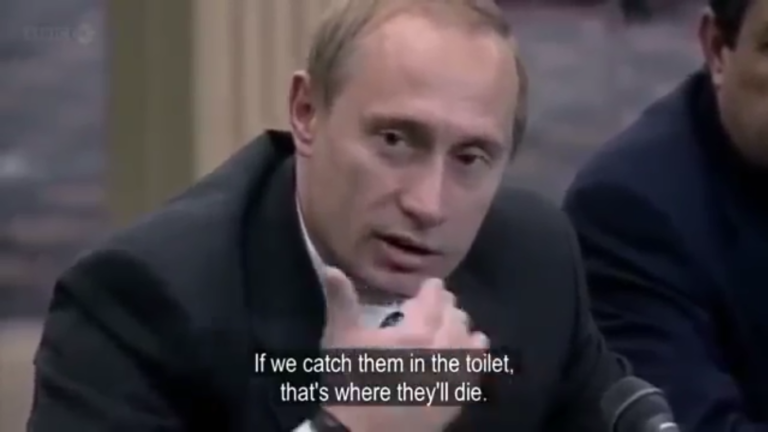
According to reports, the phrase was spoken on September 24, 1999 at a press conference in Astana. Putin was prime minister of Russia at the time, and he spoke about Russian aviation's actions against militant bases during the Second Chechen War. He stated that militants would be pursued everywhere, including at airports.
In retellings the date, place and circumstances differ, and a full transcript is not available. In the RIA Novosti version the quote reads: “...we'll catch them in the toilet, we'll whack them in the john, after all.” Which exact speech is captured in the frame is unknown.
What is visible in the frame
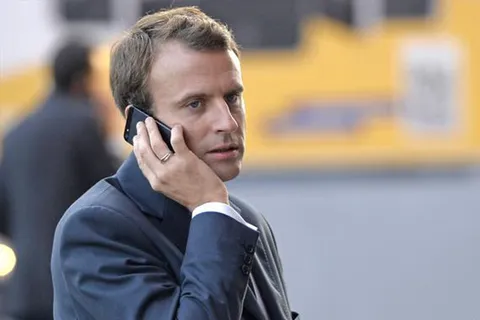
The frame is taken from a video with English subtitles. A man in a dark suit sits with a hand raised to his chin, the thumb extended, his gaze directed toward an interlocutor outside the frame. On the right the edge of a second person's shoulder in a dark jacket is visible, and at the bottom the edge of a microphone.
The subtitle translates the phrase into English as “If we catch them in the toilet, that's where they'll die,” which is a translation, not the original text. The intonation in the frame looks concentrated, while the harshness of the wording is added by the on-screen text, and the gap between the calm face and the words makes the frame stand out.
Two forms of the phrase
Retellings contain two forms. In the popular version it is “whack them in the john,” while in the quote cited by news agencies it is “we'll catch them in the toilet, we'll whack them in the john.” The meaning is the same, but the first form became the name of the meme and stuck in memory.
The phrase came back up later as well. On May 23, 2023, presidential press secretary Dmitry Peskov stated, according to TASS, that everything said at the time in connection with the fight against terrorism is still relevant today. That comment became a new occasion for discussion, and with it for jokes about the style of speech.
Why a rough word works as a meme
The main mechanic here is contrast. Official speech involves bureaucratic formulas, but this statement used a colloquial word from everyday vocabulary. When such a register is joined to the topic of terrorism, the viewer notices the mismatch, and the humor comes from the tone itself.
The meme is easy to transfer to any situation where a trivial matter (a report, a faucet, an alarm clock) suddenly takes on the tone of an official statement. The captions mock not specific people or violence, but the style itself: solemnity, awkwardness, and the habit of turning small problems into decisive declarations.
Caption examples and why they work
Below are four standalone examples. All of them transfer official tone to an everyday situation.
“I'll deal with this report once and for all.” It is said firmly, yet the document has not even been opened. The formula “once and for all” demands decisive action, but the matter stays empty, and the gap between the words and the deed is funny.
“The question is closed once and for all.” This is what someone says after closing one browser tab with a conversation. The solemn wording sounds like the finale of an investigation, while in fact it is about an annoying chat that has been hidden from view.
“Every leak in the apartment will be fixed personally.” The word “personally” adds weight, while the subject is a dripping faucet, so the joke relies on the scale of the promise.
“Problems like this will not happen again.” This is said about an alarm clock that failed to go off again. The statement about the future sounds like an official promise, while the subject of conversation remains mundane.
How to approach the template
The template is most convenient for stories about style and speech habits, rather than for topics tied to specific people and violence. That keeps the joke at the level of language.
The person depicted is a public figure, and the quote is on record. Captions can be built on its wording and context, without inventing new statements or attributing other people's words to the figure.