What's shown
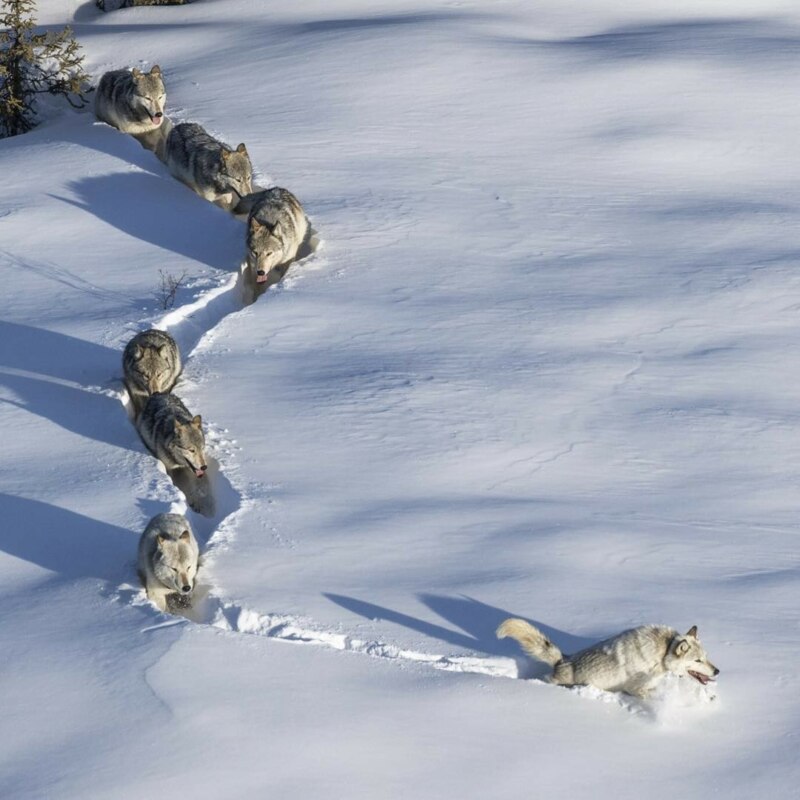
The photograph shows six or seven gray wolves lined up in a row across deep winter snow. They walk along a trodden path winding along a slope, while one animal confidently moves ahead, almost into the lower right corner of the frame. The snow is bright and textured, the shadows from the trees fall in long stripes, and the whole scene looks calm and even solemn. It was this striking, contrasted scenery that became the basis for the caption.
The composition itself suggests the plot: the wolf in the lead is noticeably set apart from the rest and looks more confident than those following in its tracks. For the meme, that was enough to turn an animal scene into a recognizable metaphor.
The caption text
The caption that stuck to the picture is written in the spirit of a self-admiring monologue. The wolf seems to speak about itself in the third person, marveling at its own strength and mighty paws. In Russian slang, the word "volchara" (literally "big wolf") refers to a tough, self-assured man, so pairing it with the adjective "woolly" sounds both ridiculous and recognizable. It was precisely the tone of the phrase that carried the humor.
The exact author of the caption and the place of its first publication are not known. Most likely, the text arose among social media and forum users as a joke about typical workplace behavior, and was later paired with a photograph that fit the scenario well.
How the meme spread
The picture became noticeable in 2017, when it began to be massively reposted in Russian-language communities. It worked well as a brief comment: it was enough to drop it into a feed under a story about a boss who takes on someone else's work, or about a colleague who loudly presents the team's results as their own. The image conveys the idea without extra words, which is why it's easy to recognize even without the caption.
Over time the meme moved beyond office stories. It was used to describe sports teams, family relationships, and any situation where one participant leads the group while being prone to self-admiration. The phrase "god, I'm so good" became a universal label for this kind of behavior.
Variations and remixes
In remixes, the line was most often changed. Users wrote their own demands, complaints, or boasts into the leader's monologue, and the wolf turned into a character who recognizes itself in every new text. Sometimes the caption was replaced with a question or an ironic admission, and then the picture worked as a gentle reproach.
There's also the opposite scenario: the meme was used for self-irony. A person would portray themselves as the one blazing the trail, while emphasizing the absurdity of that pose. This approach made the joke good-natured and kept it from turning into mockery of a specific person.
Cultural context
"The Woolly Wolf" belongs to the category of memes that rely on a recognizable visual and a short line. A key detail here is that the photograph itself is documentary and beautiful — without the caption it looks like a frame from a nature documentary. The caption shifts it into an everyday context and makes it funny.
Today the picture is often recalled as an example of how the Russian-language internet finds human storylines in the animal world. The meme keeps appearing in comments, and its recognizability rests on a simple formula: a strong leader, an obedient pack, and a monologue in which the leader is a little too pleased with himself.