Three wolves and three expressions
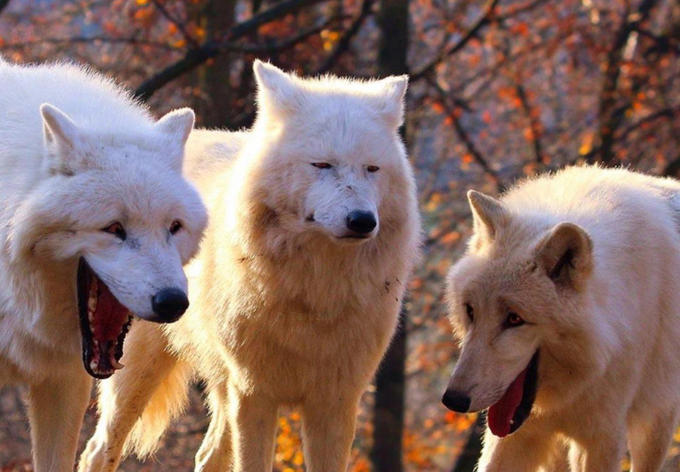
On the left stands a wolf with its mouth wide open, showing a red tongue and teeth. In the center is a wolf with narrowed eyes and a closed mouth, its nose black, its gaze seemingly directed sideways. On the right is the third: its mouth is slightly open, its tongue sticks out, and its head is tilted slightly. All three have light, almost white fur, and behind them are blurred trees with red and orange foliage.
The composition tells the story on its own. The two on the sides seem to be laughing, while the one in the middle is the one being laughed at. This distribution of roles is what made the photo a convenient template.
What the photo actually shows
According to available reports, the original photo was taken by photographer Tereza Hola at a zoo in the Czech Republic. It was titled “Global Yawning,” a pun on “Global Warming,” and appeared on DeviantArt in April 2019. The wolves in the photo are not laughing. They are yawning.
The image of “laughing wolves” emerged later, when the photo began to be accompanied by captions and editing. According to the same sources, the first notable meme version appeared in May 2020 on a Facebook fan page for animals, after which the photo spread to Twitter, Reddit, and Instagram.
How to read the arrangement
The typical reading goes like this. The two on the edges are friends or colleagues who are teasing. The one in the middle is the person being teased, or the author of the caption itself. Sometimes the captions are set up differently: each wolf gets its own line, and they show how three inner voices argue with each other.
The nuance is that the real emotion in the photo is a yawn, and we supply the laughter ourselves. That is why the meme adapts so well to any meaning: it has no required intonation.
Caption examples
Left and right: “You said you'd assemble the wardrobe yourself.” Middle: “I just wanted to save money.” A joke about an overconfident decision that friends will never let you forget.
“My friends, when I say I'll start running from Monday” is the caption under the side wolves. Over the middle one: “Me, on Monday.” A classic story about postponed plans.
“Me and my left hemisphere laughing at my right one.” A variant for inner conflict: two laugh, one stays silent.
“Colleagues watching me try to open the presentation” applies to all three wolves. Here the whole trio is on the side of the laughers.
Why the template works
Three figures give three roles, and the expressions are understandable without captions. There are no faces of specific people, so you can joke about anyone, from a school class to a development team. The animals add softness: the teasing looks not mean, but rather friendly.
The picture is easy to edit: you can remove an extra wolf, add a caption to each one, or recolor the background. The template handles such changes and still remains recognizable.
How to use it
Choose a situation where there are people laughing and someone being laughed at. Label the wolves with short names: “friends,” “boss,” “me.” If you want to show an inner argument, give each wolf its own line, but don't overload the picture: three short captions read faster than a long paragraph.
Avoid captions where the teasing targets real people: the template works best as a play on situations, not as a tool for bullying.