From a street question to an international discussion
In April 2024, the Screenshot HQ account posted a street poll in which women were asked whom they would rather be in the forest with: a stranger or a bear. In the episode shown, seven of the eight participants chose the bear. This result applies only to a small group of respondents and is not a representative study of all women. But the unexpected choice made the question widely discussed, and the answers became a reason to talk about how people assess the risk of violence and the likelihood of being heard afterward.
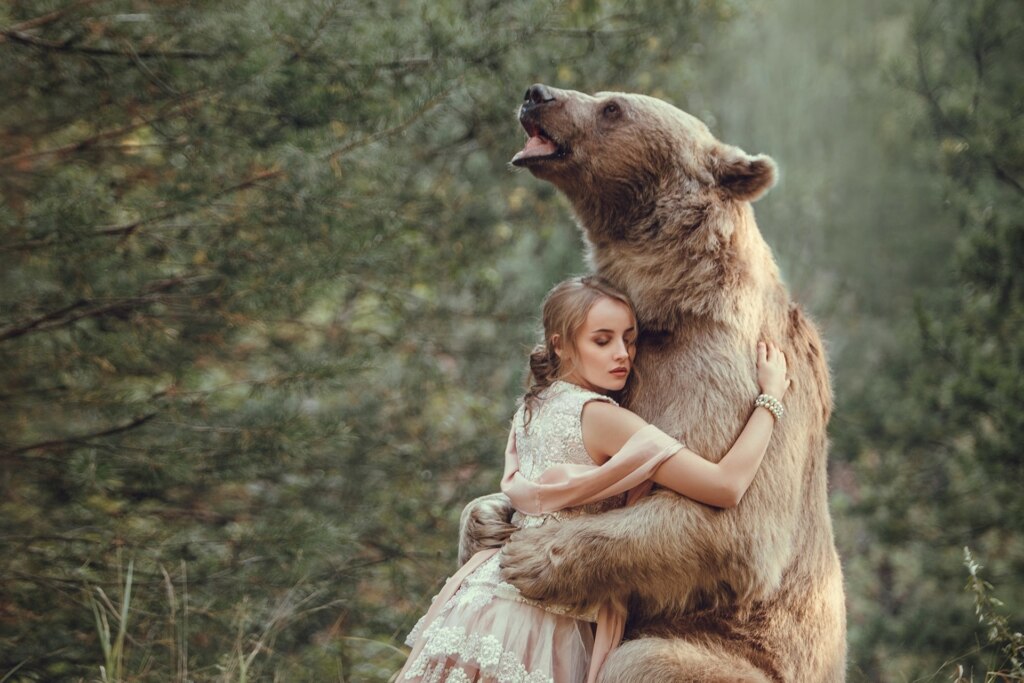
The local file is not a fragment of the report but a photomontage: a young woman hugging a very large bear. Its unrealistic scale and staged look take the hypothetical to a fairy-tale extreme. It should not be taken as a real encounter, an illustration of statistics, or proof that any wild animal is safe. The meme image simply embodies the chosen answer and contrasts a human gesture of tenderness with a dangerous beast.
What people argue about beyond the literal choice
Participants in the viral videos explained their answers in different ways: the unpredictability of a stranger's behavior, fear of sexual violence, worry that others would not believe the victim. For part of the audience, the question became not a comparison of physical danger but a way to show how predictable everyday social risk can feel. Critics pointed out that meeting a bear is also dangerous and depends on the species, the distance, and the circumstances. So the meme gives no practical advice for hiking; it conveys a social statement and an emotional reaction.
It helps to distinguish the question as a viral thought experiment from a real risk assessment. People's answers are data about perception and trust, not a count of attacks. Much of the dispute lies in this difference: one camp hears a claim about safety, the other a protest against ignoring women's experience.
Captions that keep the meaning of the question
For a school project, you could show two folders and write: "Pick one: defend your work in front of the committee, or ask yet again why the file format is wrong?" The caption turns a dramatic choice into a harmless comparison of two annoyances; it uses the form of the question but does not replace the original social context. Another option: "On a group call: a stranger's question or the familiar bear of deadlines?" Here the beast is a metaphor for piled-up tasks, not a person.
For the local montage, a careful caption would be: "Me picking the bear in the poll, then seeing how gently it hugs." The contrast between the absurd composition and the serious topic creates a surreal joke. These are original examples, not answers from real participants and not a claim about animal behavior.
How to discuss the topic with care
If the meme is used in a conversation about safety, do not reduce it to mockery of women, or of men in general. It is more useful to say what exactly is being discussed: fear of attack, distrust, the reaction of bystanders, or the viral logic of the poll. For a lighthearted video, you can move the structure to deadlines or queues, deliberately leaving real violence off screen. That way the viewer does not have to guess whether the author is mocking a particular group of people.
Do not turn the image into advice to approach a wild animal: bear behavior is unpredictable, and a photomontage says nothing about safety. And do not pass off eight interviews as a scientific sample. The meme can start a discussion, but the causes and scale of violence call for independent data and careful attention to the testimony of victims.