What is visible in the image
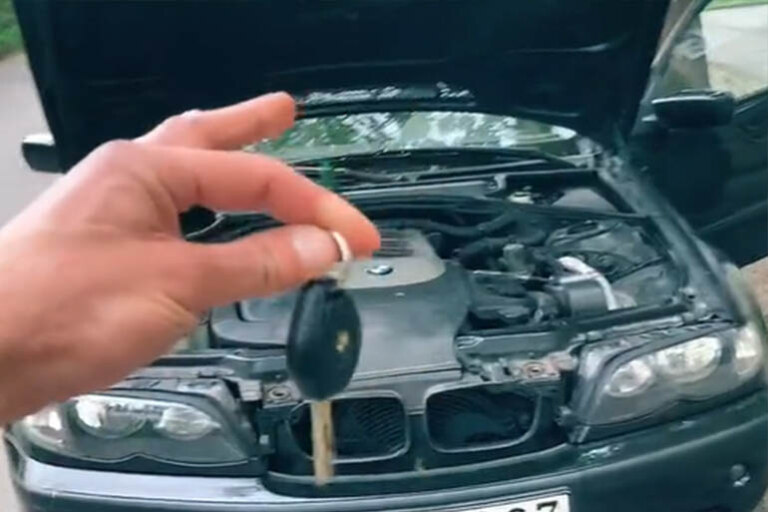
At the center of the frame is a car shot in close-up, and a hand reaching for the side mirror. The composition looks like a frozen fragment of a household video: the action has already begun, but from a single frame one cannot confidently tell how it will end or why the author acts this way. The short phrase over the video sets a mood of deliberate defiance: if the thing wants to break, let it break, nobody is going to worry.
The English “sunshine” functions here as a familiar form of address, almost an affectionate nickname. The contrast between the tender word and the crude expression amplifies the comedy. What matters is not the literal advice to damage a car, but the demonstrative “I don't care.” That is why the image is usually read as a reaction to pressure, a breakdown, or a situation that cannot be controlled. The meme caption turns the tense gesture into hyperbolic bravado.
Why the phrase became a handy template
The formula rests on three steps: addressing a thing as if it were an interlocutor, an emphasized “I don't care,” and a clownish permission for the problem to happen — which yields a short monologue of a person whose patience has run out. The first part sets the intonation, and the final “let it break, break all you want” pushes the indifference to absurdity. The phrase transfers easily to other scenarios because it requires no knowledge of the specific author of the video or its backstory.
The Russian version of the caption mixes an English form of address with colloquial speech. It is precisely this clash of registers that makes the quote memorable: “sunshine” sounds soft and almost cinematic, and the following line sharply brings the pathos back to earth. At the same time, crudeness is part of the character's comic voice, not a mandatory requirement for every variant. In a friendly chat the same idea can be expressed more neutrally: “well, fine, we'll sort it out later.”
How to use the meme
The template suits everyday mishaps that are unpleasant but not catastrophic: a frozen app, a broken trinket, plans that have changed again, or endless notifications. A good caption describes a personal decision to let the situation go — for example, “I after the third rescheduling of the meeting” or “the laptop asked for an update again right before the call.” In such a context the meme expresses self-irony, not a wish to harm someone else's property.
A scene with a car and a sharp gesture can be read literally, so it should not be used as a threat to a specific person or as an endorsement of dangerous behavior on the road. If the audience is unfamiliar with the template, caption the video so it is clear that the subject is irritation and hyperbole. The swearing can be replaced with “oh, let it already break” or “I don't care, sunshine” — the rhythm and contrast will be preserved.
Variants and limits of interpretation
In text remakes, the mirror can be replaced with any object that symbolizes a tiresome problem: a printer, an alarm clock, a to-do list or another deadline. Such frames are captioned with phrases like “I don't care, alarm clock, ring until you're hoarse” or “Fine, let it be, printer, jam the whole pack.” In a short video, the repetition of the phrase works before a minor malfunction: first the person pretends to be in control of the situation, then delivers the line and steps away from what is happening. The smaller the real damage, the clearer the comic effect — a grand reaction to a trifle.
Open sources record the spread of this caption in short videos, but the exact original author of the specific frame and a single date for the template's appearance cannot be reliably established. Therefore it is more accurate to describe what is seen and explain the meaning of the phrase, without attributing to the video an unconfirmed history. The meme is not reliable evidence of anyone's actions: the frame can be taken out of context, edited or given a new caption. Its recognizable part is the verbal pose of indifference.