From invitation to road trial
English bae is an affectionate term for a loved one, related to babe. In online jokes the phrase “Bae, come over” quickly turns an ordinary message into a little scene: one person says nobody is home, the other imagines a romantic evening, but the trip unexpectedly becomes the main event. The invitation itself stays short, while the journey grows into an exaggeration.
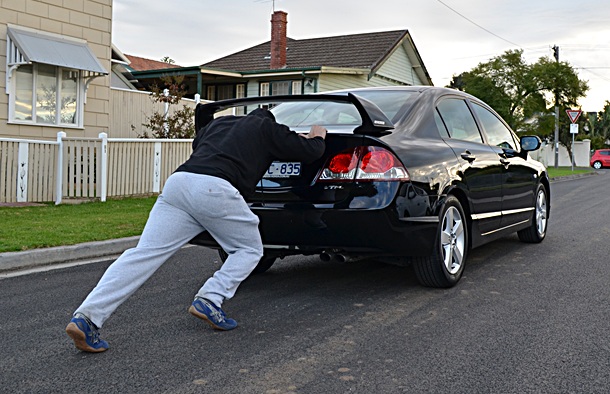
One of the early well-known illustrations is dated January 11, 2014: in it a man pushes a car to get to a girl. The post is linked to the FunnyPicsDepot account, though the original post can no longer be opened directly. Soon Vine picked up a similar idea: Jack Leonard filmed a short sketch in which a guy overcomes obstacles to reach his girlfriend. This shows the early shift from caption to action, but it does not establish a single author of the expression or a specific photograph.
The photo has no text: a man presses his hands against the back of a car and leans forward. The trunk is closed; the horizontal piece above it is a spoiler, not a raised lid. The image turns the desire to arrive into physical effort: the hero seems unwilling to wait for the transport to get going again. The circumstances of the shoot and the man's identity are not established; the romantic premise is added by the meme caption.
Why an ordinary request turns into a quest
The joke works on a difference in scale. The other person wrote two short phrases — “come over” and “parents aren't home” — and the meme answers with a journey that looks disproportionately difficult. You can imagine the hero dragging the car, crawling through snow, or crossing the city on a broken bicycle. The more mundane the invitation, the more noticeable the exaggeration.
The shift in expectation matters here too. The messages promise intimacy and convenience: an empty house seems to remove every obstacle. But the photo reminds us that a real road lies between the message and the meeting — with traffic, breakdowns, weather, or simply an awkward route. It is this gap that turns the message into a miniature plot rather than a straightforward romantic scene.
Invented captions: difficulties on the way
Invented caption: “Her: come over, nobody's home. Me: pushing the car, because waiting for it to start takes longer than walking, and walking takes too long.” The text keeps the invitation short and carries it straight onto the frame: the hero pushes the car by hand, as in the photo, instead of dealing with the breakdown.
Another version: “Bae: come over, nobody's home. Me: bracing the car with my shoulder, because it won't move any other way.” This is not the story of the man in the photo but an invented continuation: the hero chooses to move the vehicle under his own power rather than wait for help, and answers the short message that way.
The roles can be swapped: “Me: come over, nobody's home. Bae: still pushing the car in their own yard.” Then the host becomes the voice of the invitation, and the frame illustrates the guest's delay. The format does not assign a gender to the participants or require a real couple — a short invitation and a photo of effort by a car is enough.
From a verbal meme to an action photo
The frame works because of the visible effort: the leaning body, the outstretched arms, and the car make the persistence visible. In other versions the same role can be played by a video game, a huge detour, or the need to hurry and finish some work. Often the decisive element is a clarification after the invitation: earlier the hero might have refused, but an attractive reason changes his decision. The sequence of messages then shows a sudden change of mood, and the photo takes this new determination to physical absurdity. The format preserves not a specific breakdown, but the willingness to overcome a disproportionate obstacle for the promised meeting.