Country life ended in irritation
The scene takes place in the episode “Mac & Dennis Move to the Suburbs,” the fifth episode of season eleven. It aired on February 3, 2016. Mac and Dennis move to the suburbs, expecting more space for less money, but the new daily life turns out to be far from pleasant. Dennis commutes into the city, while Mac takes on cooking at home and regularly serves his macaroni and cheese.
The repeated dinner becomes a source of irritation. Dennis accepts a plate and then hurls it toward the hallway. The short action became material for GIFs already in 2016. A new wave of edits appeared in February 2018: users placed the serving of a dish next to its being thrown away, captioning people and food as participants in their own conflict. By March the format was spreading noticeably on Reddit and Facebook. The original everyday story gave the meme a clear sequence that could be transferred to a completely different offer.
A calm serving before the sudden movement
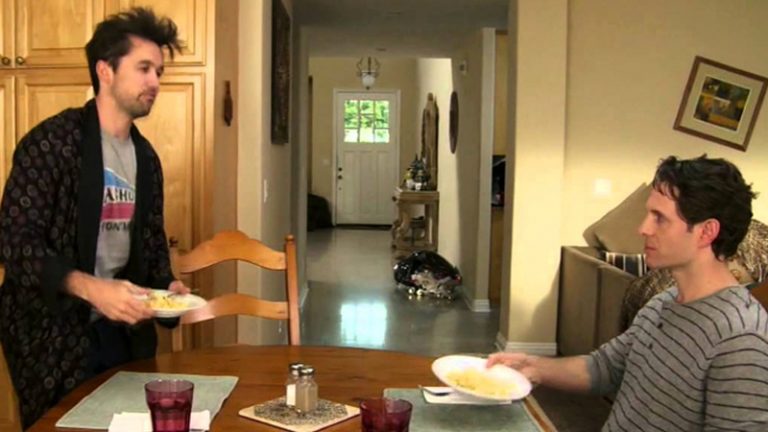
In the image, Mac stands on the left by the kitchen cabinets. He wears dark home clothes over a gray T-shirt and holds a white plate. Dennis sits on the right at a wooden table in a gray striped sweater; another plate is in his hand. Purple glasses, a salt shaker and light coasters are visible on the table. Behind them a long corridor opens with a door at the end.
There is no flying plate in this frame yet. He holds the moment of the handover and the recipient’s reaction before the throw. In a two-panel edit, exactly such a calm episode is needed for the later outcome: first the offer looks ordinary, then it is suddenly rejected by a physical action. In a single-image version, the familiar frame can lead the viewer, who has already seen the scene or template, to expect the throw.
The offer gets its own caption
The format conveniently distributes three roles. Mac can stand for a person or system making an offer; the plate is the object of the offer itself; Dennis is the recipient who does not want to accept it. Thanks to this, a long line of reasoning is compressed into two actions. The offer is shown as a caring or habitual serving, while the refusal looks disproportionately energetic.
At the same time, the captions change the evaluation of both characters. Sometimes Dennis plays a stubborn person rejecting a useful opportunity. In another version he frees himself from an imposed idea, and the throw becomes an exaggeratedly joyful refusal. The same scene allows both readings, because its comedy rests on the gap between the polite procedure of making an offer and an unexpected form of reply. The flat expression on his face strengthens the effect: the decision seems to have been made in advance and needs no explanation.
A plate with three new offers
In the first invented version, Mac is captioned “the man who knows a shortcut,” and the plate is “one more turn through an unfamiliar yard.” Dennis plays a passenger who is already in the same alley for the third time. The throw becomes a comic refusal to continue the experiment. The reason is clear from the story of repetition, which is structured like a dish that has grown tiresome.
In the second example, a streaming service offers the recommendation “watch the same thing, just with a new title.” The recipient wanted to find a different genre and throws away the conventional plate. The joke transfers the physical reaction onto the menu of a digital service: the calm offer from a device receives a human refusal of unusual force.
The third version changes the side of the mockery. The plate is captioned “save your work before the restart,” and Dennis is “I’m sure everything will restore itself.” Now the character rejects a reasonable action. The implied next misfortune makes his resolve look funny and absurd. All three sketches use the clear path of the object from the one offering to the recipient, but they show different grounds for refusal: accumulated irritation, a desire for change and self-confidence.