What the image shows
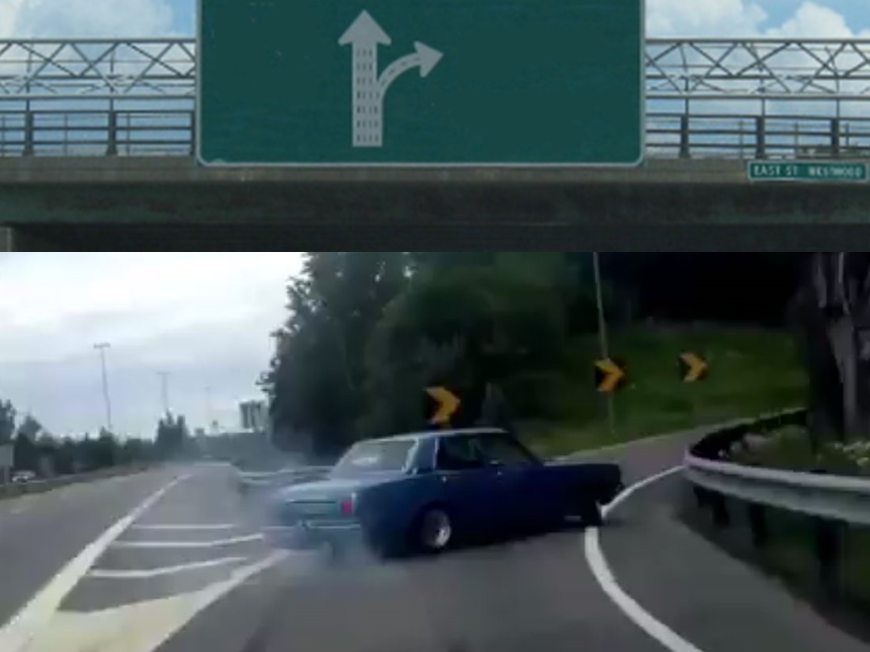
The top frame is a road sign above a highway: a green board with two white arrows, one pointing straight ahead, the other branching off to the right. Next to it, on a smaller plate, the words “EAST ST WESTWOOD” are legible, an ordinary street sign with no connection to the joke. The bottom frame is a video of a blue sedan that swings wide into a right turn, with smoke rising from its rear wheels. The road is marked with yellow turn chevrons, and there is a guardrail and trees along the shoulder.
An important detail: the sign itself carries no captions such as “good” or “bad,” just two neutral arrows. The meaning is added by users, who label the straight arrow as the sensible option and the right turn as the knowingly bad one. This should be kept in mind when describing the meme, rather than attributing text to the sign itself.
Mechanics of the joke
The joke is built on a mismatch between advice and action. The sign with two directions reads as a metaphor for choice: one path is sensible, the other impulsive. The car, captioned “Me,” ignores the obvious straight path and skids into a direction it should not have taken. The smoke from the wheels intensifies the sense that the decision was made abruptly and not fully consciously.
The format runs on contrast: the calm, almost instructional picture of the sign against a car sliding through a turn. Viewers read the situation instantly, because a fork is a universal image of choice, familiar to anyone who drives or has simply looked at road signs.
How the captions are used
Captions are added to both halves of the picture. Above the straight arrow goes something sensible, such as “Go to bed on time,” and above the right-turn arrow a tempting but harmful alternative: “Watch one more episode.” The car itself is captioned “Me,” or with the post author's name, to emphasize self-irony.
Sometimes only the bottom frame with the car is captioned, leaving the top sign as a wordless hint. The context is then read from the composition alone, a fork plus a skid, familiar from earlier versions of the meme.
Contexts of use
Most often the meme is applied to everyday weaknesses: choosing between healthy eating and fast food, between work and procrastination, between saving and an impulse purchase. The template fits any situation where a person knows the right option in advance but picks the opposite.
The format is also used in professional and gaming communities, for example in jokes about choosing between a stable and a risky decision in a project or a match. The common denominator is irony at one's own inconsistency, not ridicule of a specific person.
Origin and dating
The sign and the drifting-car video are two separate sources that someone combined into a single template. Who first put the sign and the skidding clip into one picture, and when, is not known. The date the template appeared is not established.
The filming location of the car video is also not established: the road and guardrail give no unambiguous clues, and the lettering on the small plate by the sign refers to another object and does not indicate the source of the clip.
Meaning of the format
The meme rests on a simple visual equation: fork plus skid means a deliberately bad choice. This construction carries easily to any topic, because it needs no explanation; it is enough to caption both halves.
The format remains popular because it speaks not of external circumstances but of an inner contradiction: a person knows what is right and does otherwise anyway. This kind of self-irony is universal and needs no tie to a specific event or persona.