How to read the four panels
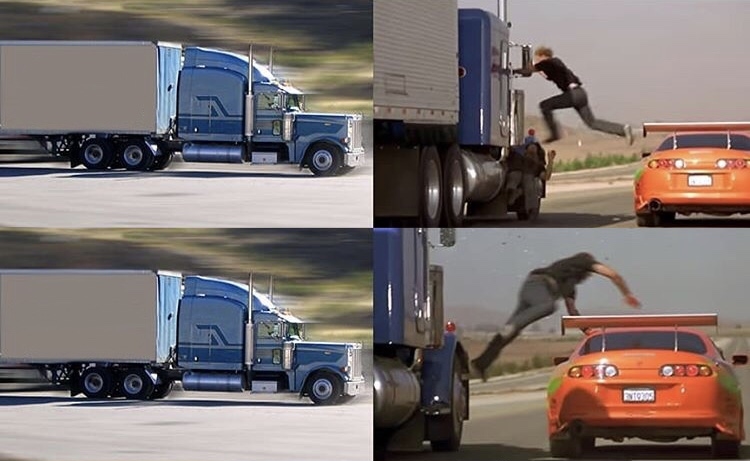
The left column holds two similar frames: a blue semi-truck tractor with a gray van on the road, the background slightly blurred by motion. On the upper right, a man in a dark T-shirt and gray trousers, mid-jump, reaches toward the side of the truck next to an orange car. On the lower right, the same man is already in the air above the rear spoiler of the orange car, with his body turned the other way.
Panels are usually read left to right and top to bottom, like a short comic strip. This creates rhythm: here is the goal, here is the jump, here is the turn. In captions, each frame usually corresponds to a separate step of reasoning.
What is known about the scene
The orange Toyota Supra is known from the first film of the “The Fast and the Furious” series (2001), where it is the car of the hero Brian O'Conner. That is why the template is linked to this franchise. Nevertheless, the exact scene and the order of the frames within it are not confirmed, nor is which crew member is shown making the jump, which is why the actor's name is not given and it is better to build the caption on the picture itself.
The origin of the meme and the date of the first joke with this template are also not established. There is no information about who first put the four frames together into one picture.
Why the joke works
The meme is built on the idea of choosing between two options. The truck and the orange car are replaced in captions by two life paths: the right and the pleasant, the hard and the easy, the promised and the real. The movement back and forth shows that a choice was made and then reconsidered.
The dynamics matter too. A body in the air means the decision was made on the move, with no time to think. This gives a sense of impulsiveness that works well for jokes about habits: promising one thing and doing another.
One more device: the size of both frames on the left is identical, so the viewer immediately sees that nothing has changed up to that point. New information appears only on the right, so the turn in the caption feels stronger.
Caption examples
Four invented captions, each in two or three beats.
“Monday: I'll save money. Tuesday: save, but first, this.” The first beat sets an intention, the second cancels it.
“Decided not to eat sweets. Saw a cake. Decided it counts as dessert already.” Each step on its own sounds reasonable, and the outcome is funny precisely because of the small excuses.
“In the evening: going to bed at 22:00. At 22:01: one more episode.” The time in the caption makes the gap more noticeable.
“New Year: running in the mornings. January 1st: running, but after breakfast.” The holiday highlights that the start was too ambitious.
Tips for using it
Captions in two or three short beats work best: the start, the turn, the return. If there are too many steps, the rhythm of the comic is lost. It is convenient to place captions under each panel separately, or in two columns so that the left column names the original intention and the right one shows the jump.
Topics of habits, finances, diets, sleep schedules, and work plans all fit well. Serious situations where the choice carries real harm are less suitable: a jump on a highway is dangerous, and it is not worth repeating in real life.