What is in the frame
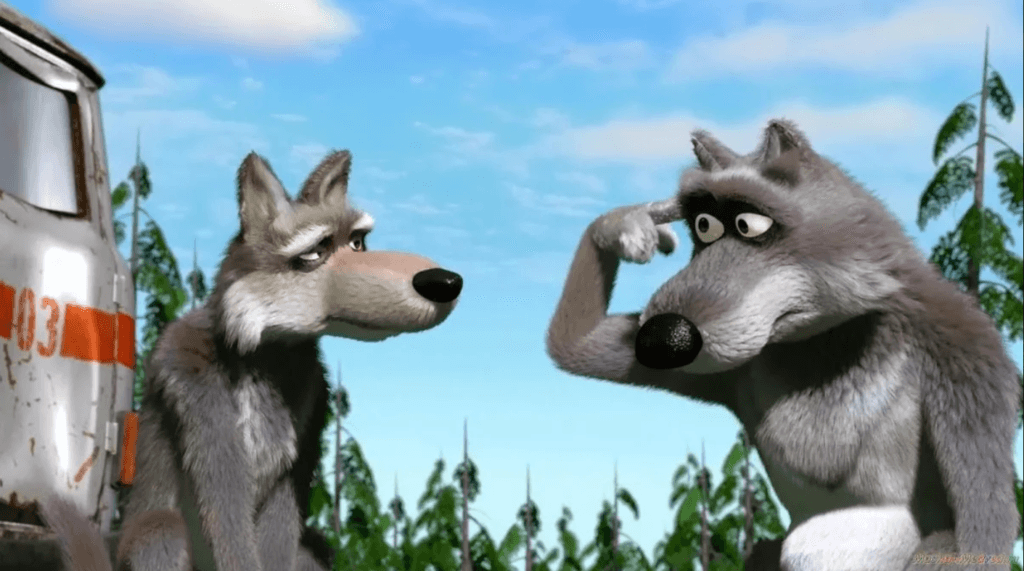
The frame shows two wolves against a blue sky and young fir trees. On the left, at the edge, stands an old white car with an orange stripe and the number “03” — an ambulance. The left wolf sits sideways and looks to the right, eyelids lowered and one eyebrow raised; his gaze is skeptical. The right wolf, with wide-open eyes that slant to the side, presses a finger to his temple and seems to twirl it. The background is bright 3D animation.
The frame has not one wolf but a pair of characters, and it is the interaction of the two that makes the frame expressive: one makes the gesture, while the other looks as though he has already heard it all.
The cartoon and its wolves
“Masha and the Bear” is a Russian animated series; the wolves appear in many episodes. According to fan wiki descriptions, their home is an old broken ambulance (UAZ-452), which matches the “03” in the background. Which exact episode this frame comes from has not been established.
In the series the wolves are unlucky characters who constantly land in absurd situations and express their reactions not with words but with facial expressions — a squint, a raised eyebrow, a sharp gesture. So even without a single line it is clear that one character considers the other a crank: the frame works on exactly the same wordless grimaces that viewers already remember from the series.
What the gesture means
In Russian-speaking settings, a finger moved at the temple is understood as a playful or rough “you’re not all there.” Among friends it is good-natured mockery, while in an argument with a stranger the gesture is taken more harshly. The cartoon context softens it: two animals, fir trees and a blue sky create the feeling of a children’s fairy tale.
It is impossible to date precisely when the frame began to spread as a meme; there is no reliable date of first use. It is only known that it is still often used as a reaction in chats and comments.
The pair of characters adds a second layer to the joke: one wolf makes the gesture, while the other seems to have heard something like it before. In a caption these roles are easy to assign, for example between the author of a plan and the person listening to it, and then the picture replaces an entire short dialogue.
Examples for your own caption
“Colleague: let’s hold a meeting about cutting down on meetings” — the wolf as the reaction of someone who has understood it all.
“Me: I’ll take out a loan for a new console, because there’s a discount” — the reaction of the inner voice to one’s own plan.
“Friend: I’ll go to the gym today, and tomorrow straight to a marathon” — good-natured teasing.
“A planner at 6 a.m.: let’s start everything over from Monday” — a reaction to yet another repeated eternal promise.
How to use the picture
The meme works well as a short reply when writing a long comment is too much effort. It is harmless between friends, but in an argument with a stranger it is better to do without it: mocking the other person’s intelligence can turn into an insult. Do not caption the frame with names of illnesses, and do not apply it to real people who need help. If you want to soften the tone, add a laughing sticker or a playful phrase, and the picture becomes a joke rather than a reproach.
Most often the caption describes someone else’s or one’s own strange scheme in a single line, and the wolves sum it up without words. The more mundane the scheme, the funnier the absurdity of the gesture.