What is in the picture
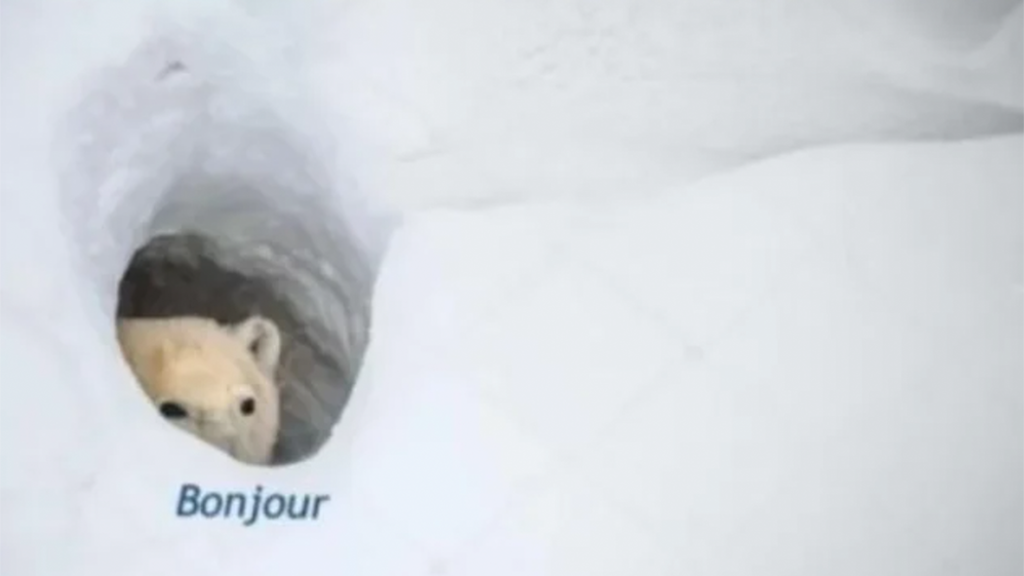
The image is almost entirely white: a snowdrift fills nearly the whole frame. At the lower left, a rounded tunnel has been carved into the snow, from which a polar bear’s face peeks out. Light fur, two dark eyes, a nose, and an ear are visible, and behind the face the inner part of the den is dark. The bear looks toward the camera, but its pose appears cautious.
Under the den, “Bonjour” is written in light blue italics. This caption was added after the original photo. The image quality is low and heavily compressed, but this does not get in the way of the meme: the simplicity of the composition makes it easy to read.
Where the photo came from
According to available information, the original shot was taken by the Russian photographer Sergei Uryadnikov, and it was uploaded to a photo stock site in November 2016. These details are not confirmed by all sources, so they cannot be fully relied upon.
The image became a meme later. According to reports, on September 3, 2019, a Reddit user captioned the photo with text saying that polar bears live in dens and peek out of them “like from little windows,” and added the word Bonjour to the picture. The joke spread, and by April 2020 a format like “Trying to fall asleep / My repressed memories: Bonjour” had appeared. Interest peaked in June 2020.
Why “Bonjour” Is Funny
The word is written in a polite, almost society tone, yet it is said not by a person but by a polar bear, and it appears at the wrong time. The result is a comic combination: a courteous greeting and an alarming sudden appearance. The French language here serves only as a light, sonorous intonation: the meaning comes not from the language but from the contrast.
The second part of the joke is the peeking out. The bear seems to hide and is about to vanish again. This is how memes depict thoughts that surface in silence: suppressed memories, forgotten tasks, awkward episodes from a decade ago.
Caption examples
Invented variants.
“Trying to fall asleep at two in the morning. The thought of an email I forgot to send: Bonjour.”
“A quiet evening. A reminder about tomorrow’s deadline: Bonjour.”
“I decided to save money. An ad for a new game in my recommendations: Bonjour.”
If you want the caption to be friendly: “Monday morning. A beloved colleague in the chat: Bonjour.” Here the bear is a kind visitor rather than an alarm.
How to use it
The template works best in a two-line layout: first an everyday situation, then the “peeking” thought. Leave the word Bonjour at the end unchanged, or the recognizability will be lost.
The caption should be short. The picture is calm and white, so the text is visible immediately, and it can be written large.
Do not add mockery aimed at specific people. The bear in this meme is a harmless observer, and the humor lies in the moment when an intrusive thought peeks out at the wrong time.
One more working technique is the mirrored presentation: first a close-up of a calm picture with a peaceful caption, then this bear appears as the second frame. The sudden change of mood emphasizes that the “guest” came uninvited and strengthens the effect. But even without a second frame the template remains understandable: one line of text above the picture and the word Bonjour at the bottom are enough for the viewer to catch the intended move.