Hitomi and the first posts
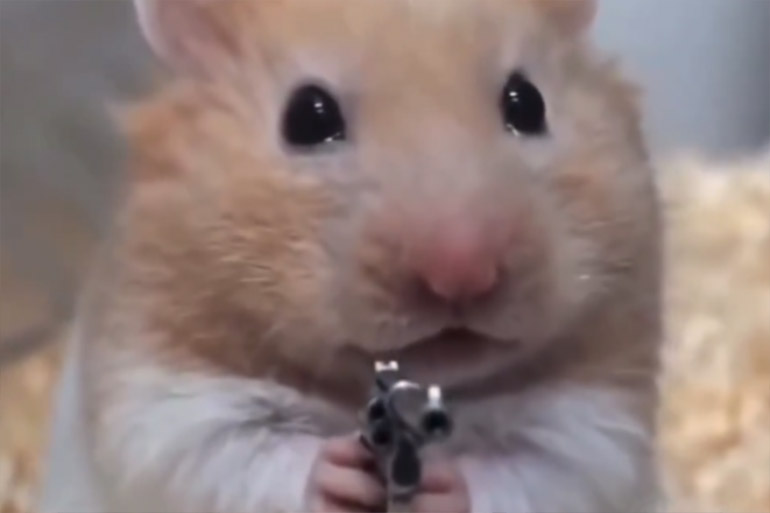
The viral clip is linked to a pet hamster named Hitomi and its owner's account, @yunyun07. The earliest original clip is unavailable: it may have been an Instagram Story from late July 2026. The owner's account still has a Reel from August 2 captioned "Sorry, I had no choice." That caption sets a dramatic tone that the meme versions later picked up.
The shot quickly broke away from the original post. Among the earliest surviving meme posts is one by X user @areeeyaaarrr from July 28, captioned about trying to stand up for oneself and crying; other variants about failed revenge and an argument appeared the next day. Later the image circulated as a short video, a still frame, and a GIF. The names Hamster Holding Gun, Hurt Hammy, and Hamster Wif Gun describe the same visual motif but not necessarily one specific caption.
The image shows a ginger-and-white hamster with an object resembling a small revolver in its front paws. It's pointed toward the camera. The large, glistening eyes give the impression the animal is about to cry; this is the viewer's perception, not a statement about its actual mood. The shot preserves both the object and the facial expression, so the comedy arises even before any text is added.
A revenge plan that ended in tears
The meme's basic formula rests on a sharp shift between intention and reaction: "I was going to get back at them," but "I felt sorry," "I changed my mind," or "I got upset myself." In one of the early posts, the meaning is phrased as an attempt to stand up for oneself that ends in tears. Other variants transfer the same breakdown onto revenge against a person who wronged the narrator, or onto an argument where it turned out the narrator was wrong.
The miniature object creates an image of a threat that immediately turns into a parody of itself. The preparation to fight back looks deliberately dramatic, while the eyes and the hamster's small size undercut the pathos that was just built up. The caption usually turns the joke back on the narrator: their angry speech stayed imaginary, while the hurt became visible. That's why the image suits a mix of irritation and vulnerability, not just rage.
The contrast holds even in a thoroughly mundane version. A person might type out a long message, reread it, and replace it with a short "fine, never mind." The picture turns giving up on a conflict into a tiny melodrama: the character is still holding the prop, but the expression already speaks for them.
Four captions based on the early posts
"I finally decided to stand up for myself. Then I imagined the other person getting upset, and apologized first." The first line promises pushback, and the rest defuses the conflict.
"When you prepared a comeback for an argument, but a search confirmed the other person was right." This version repeats one of the meme's early plots: resolve gives way to admitting a mistake.
"Wrote an angry message. Reread it. Replaced it with 'okay, it happens.'" Here the object stays part of an imagined scene, while the punchline is in deciding not to send the harsh text.
"Wanted to get back at a friend by not sending them memes. Lasted seven minutes." The everyday grievance makes the scale of the threat deliberately unserious. These captions aren't quotes from actual posts; they illustrate the meme's formula.
Why the hamster became a reaction to hurt
In an ordinary photo, the small prop and the moist-eyed look might seem like just a strange scene. In a meme context, the viewer already knows the formula: a person is putting on a show of readiness to retaliate while clearly looking upset themselves. That's why the same shot fits failed revenge, an awkward argument, self-defense, and any moment when emotions turned out stronger than the plan.
The first posts quickly set up two readings — "I'll stand up for myself, but I'll end up crying" and "I'll try to get back at them, but I won't manage it." From these grew many captions that kept the same gap between the menacing prop and the fragile reaction. That's how the meme became a compact, expressive response to hurt feelings: instead of an explanation, it's enough to show that resolve didn't survive contact with actual emotion.