What the picture shows
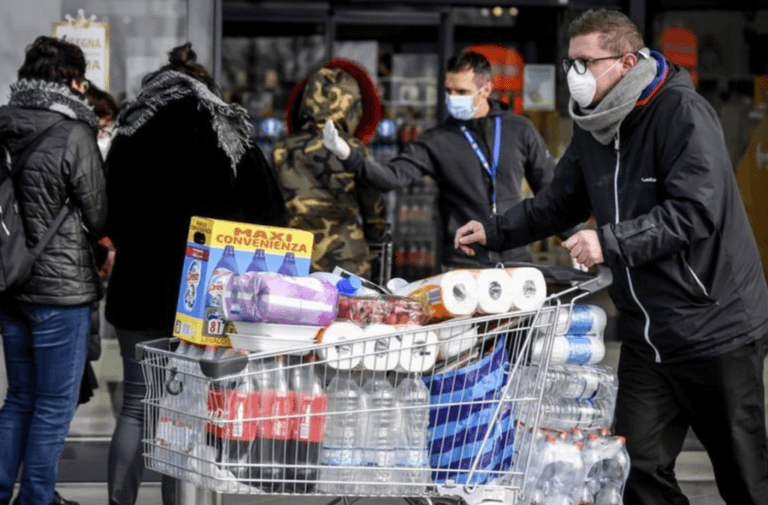
The photograph shows a man in glasses and a white medical mask pushing a supermarket cart. In the cart lies a heap of toilet paper packs, plastic bottles of water, a few bottles of cola and a large box labeled “Maxi Convenienza.” The label is in Italian, so the picture was apparently taken in Italy, but the exact place and time cannot be determined from the image itself. Behind the man, other shoppers are visible, nearly all of them wearing masks.
An important caveat: the photo by itself proves nothing about the man. Stocking up on water and paper before a quarantine is an ordinary precaution, and the joke lives in the label that internet users slapped on the picture. That's why it's better to caption such a shot about “shoppers in general” rather than about a specific person.
How the word appeared
In March 2020, when the coronavirus epidemic spread beyond a single country, stores in various countries faced a rush of demand. In Russia, jokes about buckwheat and toilet paper circulated especially in those weeks, and news sites vied with one another to publish roundups of such memes.
The word “covidiot” was picked up by Russian-language media in the third decade of March: they referred to an entry in the English-language Urban Dictionary, where the term has two meanings. The first refers to those who ignore health and safety warnings. The second refers to those who panic-buy food and household goods in quantities they clearly will not be able to use. The exact date the word was coined could not be found; it is only known that by March 22, 2020, it was already being discussed in the news.
Why the joke worked
Panic buying is a rare case where the absurdity is visible at once: toilet paper neither cures nor protects against the virus, yet the line for it grows precisely because everyone can see the line. Each shopper acts rationally on their own (what if there isn't enough), but together they produce a shortage that they themselves created. The meme plays on this trap and lets people laugh at it without feeling guilty.
The second reason is lightness. “Covidiot” sounds like a rough but homey taunt: you can poke a friend who brought home ten packs of pasta with it, or yourself. That's why the word outlasted the panic itself, and over time became a label for everyone who argued with obvious precautions. This is a harsher and more contentious usage, and it appears less often in memes with the cart.
Caption examples
The examples are invented for this article. “Me: there's enough for a couple of days. Cart: sure, sure” — the joke builds on the gap between words and facts. “Quarantine plan: survive. Actual plan: a hundred rolls” — the contrast between a grand goal and a funny way of reaching it.
“Covidiot No. 1 is the one who sweeps the shelves. Covidiot No. 2 is the one who came for the last pack of buckwheat and found nothing” — self-irony in the spirit of “we're all in the same line.” The short version works well too: “Stocking up for the end of the world. Toilet paper is the priority.” The more specific the item in the cart, the funnier it is.
How to use the template
The meme suits everyday stories best: sales, pre-holiday rushes, the habit of “buying in reserve.” It works when the joke is aimed at crowd behavior or at the author himself, not at a real person from the photo.
Don't attribute illness, stupidity or blame for product shortages to the figure in the picture. It is unknown who he is or why he was buying goods, and the meme is more interesting when the focus is on the situation rather than the person.