Serhiy Nuzhnenko's photo at the Prosecutor General's Office
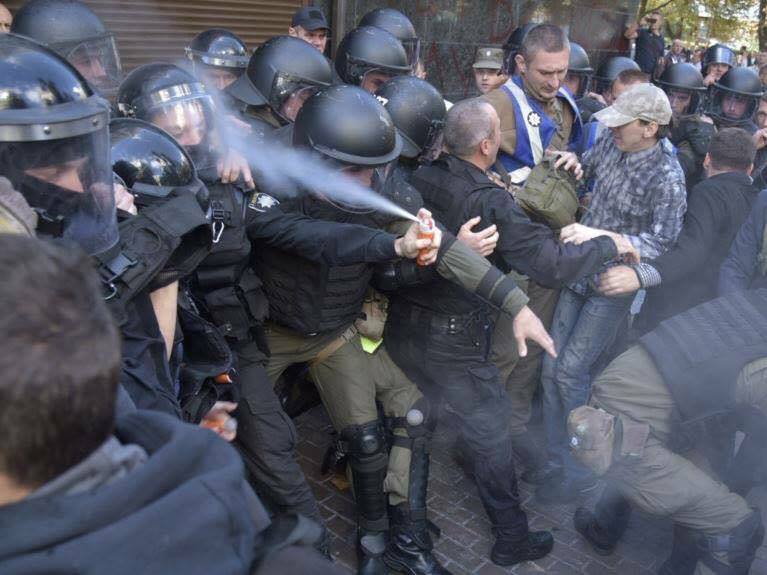
Serhiy Nuzhnenko shot this scene on September 17, 2018, during a rally outside the Prosecutor General's Office building in Kyiv. The photo report by Radio Svoboda links the protest to the extradition of Timur Tumgoev to Russia and describes clashes between police and rally participants. The frame shows people in protective gear, a crowd, and a white cloud of gas; one officer holds the canister at arm's length. This photographic evidence preserves a real event, not a staged comedy.
The photo entered a longer photo diary, where neighboring pictures show the rally from different points. Here the eye catches the diagonal of the jet and the close proximity of the people: it is hard to trace right away where the spray is aimed. The reportage caption described the officer spraying gas on himself. Later this same scene became fixed in a meme title; the cloud became its recognizable detail.
How a chance moment became a visual joke
As early as September 19, Ukrainian publications reported that the photo had spread across social networks and become the basis for photoshops. Thus the shooting date is known precisely, while the meme wave began a couple of days later. Available traces do not establish who first wrote the caption. From the news photo, the remakes inherited not a specific explanation of the clash but the recognizable geometry of the canister, the hand, and the spray.
In photos from the protest, the gas cloud is part of the overall scene; in a photoshop, the caption may assign it a comically everyday cause or consequence. In one version the text presents the action as a miss; in another, as an intervention that only complicated the original situation.
Why the spray reads as a backfire
There is little free space in the frame: helmets and shoulders almost entirely occupy the foreground. So the eye quickly finds the light jet crossing the dark uniform, and the outstretched arm sets the direction of movement. The photo froze a brief episode, but a caption can complete what came before and after it, for example by suggesting the hero wanted to solve a problem and created a new one. This causal substitution is what carries the joke.
Such a visual move makes it possible to invent different reasons without changing the frame itself: it is enough to place a clear occasion beside it. An invented caption: a person aims a sprayer at a flowerbed and forgets that he himself is standing in front of the nozzle; here the side effect literally repeats the trajectory of the spray. The same tool first promises to ease the work, then unexpectedly hits the one who switched it on.
Captions in which the tool has a side effect
Invented caption: “I meant to send the draft to myself to check the format, but I clicked 'reply all.'” Here the spray line turns into an action that reaches the wrong addressee. Another variant: “I deleted one old rule and accidentally removed access for the whole team.” In both cases the caption links an intention with a side result, but does not attribute the mistake to the person in the documentary photo.