What the photo shows
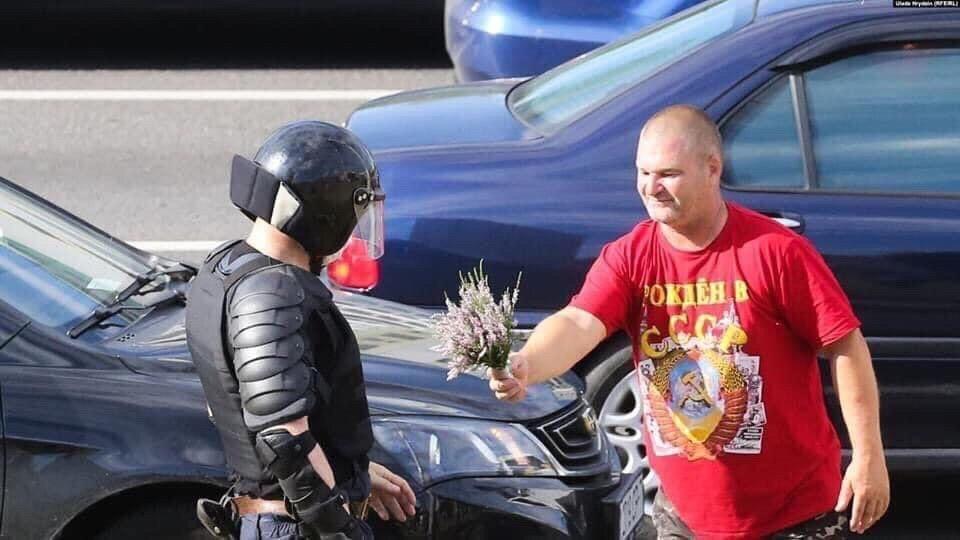
The picture shows two people in a roadway between cars. On the left, standing in profile, is an officer in a black helmet with a clear visor and body armor. On the right, facing him, stands a bald man in a red T-shirt with the words "Born in the USSR" and a coat of arms. He's holding out a small bouquet of pale lilac flowers. In the corner of the frame there's a watermark from Radio Free Europe/Radio Liberty (RFE/RL).
The man is smiling, and there's no tension in his posture: he holds the hand with the flowers calmly, at a distance. The contrast with the officer's gear is what made the shot so memorable.
Context: August 2020
After the presidential election in Belarus on August 9, 2020, mass protests swept the country, and in the first days security forces used special measures against protesters. In these events, flowers became one of the notable symbols: women marched with bouquets under the slogan that the security forces have truncheons while the protesters have flowers. International outlets, including Meduza, wrote about this.
Who exactly this man is and what happened to him after the photo was taken remains unknown: his name isn't given, and there's no information about him being detained. All that's known is that the photo went viral online in those days.
Beyond the political context, the shot also has purely visual qualities that explain its staying power: the flowers in his hand stand out as a bright spot against the dark cars and black gear, and the red T-shirt is sharply different in color from the rest of the frame. It's a composition that's easy to recognize even at a small size.
How the shot's meaning shifts in memes
The first, literal line of use: a peaceful gesture against a backdrop of riot gear. It's an illustration of tenderness in an aggressive setting, and captions for it tend to be serious. In this form, the photo was shared as a reflection of the mood of those days.
The second, everyday line: the meme turns into a template for "an attempt at kindness that looks out of place." Here the contrast between the bouquet and the armor becomes simply comic. But it's important to remember that there's a real story behind the shot, so jokes about it shouldn't be built on mocking the man in the photo or the participants in the events.
Example captions
"I apologize for going quiet in the chat for so long," with the bouquet captioned "let there be peace." The joke is that the flowers are trying to smooth over a tense situation.
"Returning my coworker's own stapler with a note that says 'sorry.'" The tenderness is aimed at the very object of the conflict, and what's funny is precisely the mismatch of effort.
"Apologizing to my neighbor for the music last night, and he opens the door already wearing noise-canceling headphones." The same mismatch: a peaceful gesture meets full-on protection.
"Coming to my boss with a new report: flowers in my hands, dread in my head." The caption reveals the speaker's inner state.
How to use the template
If you're using the shot for personal jokes, focus on the contrast between the bouquet and the gear. One line is enough. Avoid captions that mock the people in the photo, and don't put words or motives in their mouths.
If you're using it as a political illustration, state the context: August 2020, Belarus. Without that context, the photo reads as an everyday joke and erases what actually happened.