What is visible in the frame
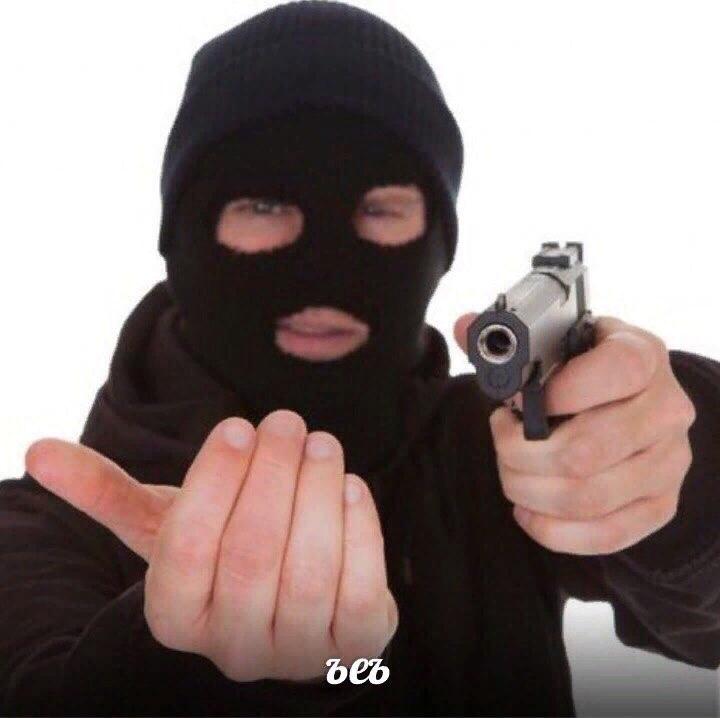
The shot looks studio-made: a light, nearly white background with no props. The man's face is completely covered by a black balaclava, with only narrow slits left for the eyes and mouth. He wears a dark sweatshirt or jacket. One arm is extended toward the viewer and holds a silver pistol, its muzzle pointed straight at the camera. The other hand is held out palm up, fingers curled, like someone demanding “hand it over.”
At the bottom center, in light letters with a dark outline, is the caption “ъеъ.” The font is decorative, with curls. There are no other captions or signs in the frame, so the entire meaning comes from three elements: the weapon, the gesture and the strange word.
What the word “ъеъ” is
There is no such word in Russian. The hard sign does not stand at the beginning of a word and cannot be a standalone sound, so the combination cannot be read or pronounced. The viewer tries to find meaning and finds none. This unreadability is the main device: the word looks like a language that does not exist, a shout, or a coded signal.
Where the caption came from, who added it and when the frame first became a meme is unknown. The shot resembles stock imagery on the theme of a robbery, but there is no confirmation of this. So it is only reasonable to say what can be seen in the image and how it works.
The mechanics of the joke
The balaclava, the pistol and the demanding gesture set up a strong expectation: now someone will say “money, quickly” or another hard condition. Instead the viewer gets an unpronounceable set of letters. The pause between “scary” and “means nothing” is where the laugh comes from.
The hand with curled fingers adds a second layer. The gesture asks for something, but what exactly is unclear. The caption “ъеъ” becomes a cryptic demand with no possible answer. That is why the frame works well as a reaction to situations where the other person speaks vaguely but sternly.
The look into the lens produces one more effect: the viewer becomes the one being addressed. The more serious the pose, the more pointless the caption looks, and the stronger the comedy.
Sample captions
The captions below were written for this frame.
“Is your report due Friday? ъеъ.” A bossy tone and an answer without words. The sternness of the question does not turn into a clear reply.
“Guest Wi-Fi password: ъеъ.” An everyday request is raised to the level of a robbery, and the password turns out to be nonsense.
“When asked to explain your idea in three words: ъеъ.” Incoherence looks like the most honest answer, and the caption stays short.
“Who took the last yogurt that wasn't theirs? ъеъ.” The “hand it over” gesture fits a family kitchen, and the hard signs sound like suspicious evidence.
How to use the frame
The frame suits absurd short lines where a stern delivery matters. It is better to leave the caption as it is: changing the font or breaking the text across lines ruins the setup, because the word and the pose are designed to work together.
Do not use the image as a real threat or aim it at a specific person: the meme works only when the threat is obviously a joke. Keep captions short, rather than explaining the joke.