What the picture shows
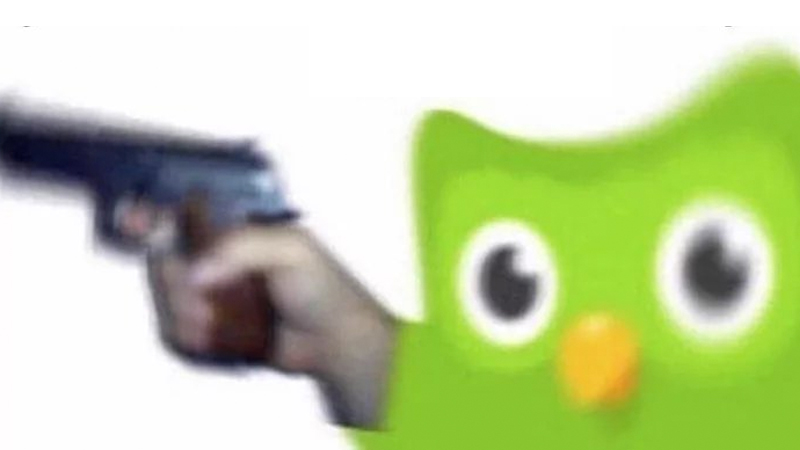
A close-up: the green head of the owl on the right, with large white eyes, dark pupils, and an orange beak. On the left, a blurred hand is visible holding a dark pistol aimed at the owl. The background is white, and the image is stretched and smeared, like a copy that has been re-saved many times.
This is not an advertising mockup but an amateur edit: the hand with the weapon is pasted into the frame, while the owl itself is taken from the app. Thanks to the recognizable mascot, the viewer does not need to be told who the joke is about.
Where the image came from
The earliest of the known versions is dated October 24, 2017. A Tumblr user posted a Photoshop edit in which the owl holds a pistol, with a caption saying the author had abandoned the app. The post gathered more than 150 thousand reactions over two years. This is the earliest example found, but it is not a proven first appearance of the image.
By then the Duolingo app had already been running for several years, and the owl was its mascot. The meme did not invent the character; it used a familiar image and added a dark twist.
How the joke became widespread
On December 2, 2018, a screenshot of a fake app notification urging the user to run appeared on Tumblr and collected more than a hundred thousand reactions. In this version the owl was already acting as a pursuer.
On March 26, 2019, Duolingo's official Twitter account published a teaser in the style of a horror film: the owl enters a dark room with the word “Soon.” Users assumed it was about a dark display theme; the company denied this, and the gloomy tone only grew stronger. Remixes on Twitter and Reddit followed in the same period, and in late March the trend was covered by news outlets. The user jokes and the official material merged, and the image settled in as a source of irony.
Why the threat is funny
The mechanics are simple: the app reminds the user about lessons, and the user keeps postponing them. The joke takes this nagging and turns it into a literal threat. The pistol serves as hyperbole here: the owl is not evil, only persistent, and what is funny is the discrepancy between the cute mascot and the weapon.
The point of the meme is not violence but guilt over one's own plans. Good captions describe the user's action, and the owl responds with a deed. The visual contrast matters more than the text, because the viewer immediately understands that the threat is a joke.
Captions that build a short story
Below are examples built on one narrative move: a confession, a warning, and an outcome.
“Skipped French for a week. The owl already knows.” A short confession, immediately followed by the mascot's reaction.
“Said I'd start learning the language tomorrow. The owl has written down the date.” The example relies on a familiar excuse, and the word “written down” turns a reminder into a case file.
“Streak broken, the owl is not joking.” A direct warning that turns an ordinary interface into a threat.
Each caption sets up a small plot, and the picture serves as the resolution. When the text is short, the joke works without extra explanation, and that is the main strength of the template.