Origin
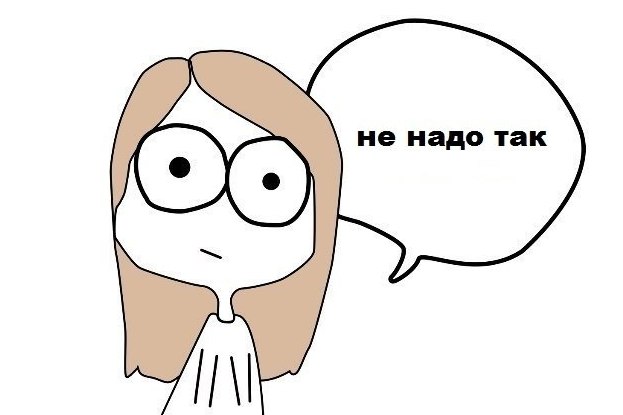
The "Don't do that" comic belongs to the simple Russian-language internet pictures of the early 2010s that quickly grew their own vocabulary and became understandable without explanation. The exact author and first publication are not fully established: the drawing is done in the minimalist style typical of homemade comics that were exchanged on forums and social networks. The meme's description gives 2013, and this is the most likely date of its appearance, but we found no independent confirmation, so the origin should be considered unestablished.
The character is drawn schematically: a pale face, shoulder-length hair, huge round glasses with black dot pupils, and a barely noticeable line for a mouth. This stylization is easy to recognize and reproduce, which made the picture convenient to redraw and add captions to. The speech bubble reading "don't do that" occupies the top of the frame and serves as the main point of emphasis of the whole construction.
Structure of the comic
The comic is built on three panels. In the first, the character demonstrates "how it should be," that is, sensible and correct behavior. In the second, she shows "how it actually happens": usually stupidity, carelessness, or outright meanness. In the third and final panel she looks at the viewer and says "don't do that." The scheme is simple but works through contrast: the ideal and the reality are set side by side so the viewer draws the conclusion themselves, without hints or moralizing.
Meaning and use
The meaning of the meme is a call to be accountable for one's words, not to do foolish things, and not to harm others. That is why in discussions it has been used in all sorts of situations: when someone replies rudely in the comments, when someone sends a message without thinking, when people behave impolitely in a queue or at the office. The comic does not accuse or insult; rather, it appeals to conscience, which is why its tone turns out soft and almost instructive rather than aggressive.
It matters that the meme is not tied to any specific topic. The first panel can describe any correct action, and the second any mistake or its consequences. This flexibility explains the picture's long life: it does not become outdated along with its original occasion and remains understandable even to those who know neither the author nor the original source. This is exactly why the phrase quickly became a short reply that can answer someone else's blunder with one word and one frame.
Cultural context
The Russian internet of that time had many comics with simple characters who acted as moral commentators, ironically illustrating norms of behavior. "Don't do that" fits into this tradition but stands out for its restraint: there is no open mockery in it, only a calm, almost parental tone. This restraint is probably what made the picture suitable for family chats, school group chats, and work discussions, where coarser memes are not always appropriate.
Today
Today the meme appears in comments, on themed forums, and in private messages as a short reply to someone else's blunder. Sometimes it is applied to oneself, as a note of one's own clumsiness. The staying power of this picture comes from the fact that it solves a simple communicative task: saying, in one phrase and one frame, that an action turned out badly, and doing so without excess solemnity and without direct reproach.