An open door and two gazes
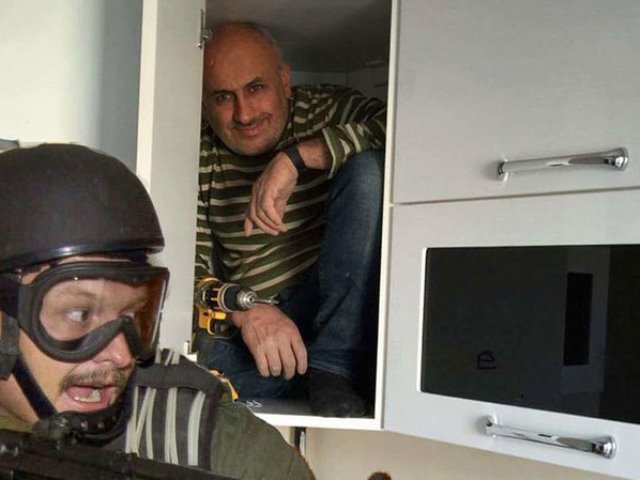
In the white upper kitchen cabinet sits a balding man in a striped sweater. He has bent his knees and looks straight at the camera; a yellow cordless screwdriver is visible near his hand. On the right is the neighboring door with a dark window and metal handles. In the foreground on the left, a person in a helmet and protective goggles, holding a weapon, is shown large.
The man in the cabinet looks relatively calm, while the armed hero’s facial expression is tense. They seem to exist in different emotional modes. The arrangement creates an extra joke: the viewer clearly sees the supposed fugitive, while the person in front of him is facing away. The door is not closed, so the hideout relies on the imagined inattentiveness of the searcher, not on any real concealment.
How a furniture shot became a search scene
The original photo of the man is connected with a demonstration of the strength of a kitchen cabinet. The person fits inside, and the structure bears his weight. In December 2016 this unusual picture became material for a photo battle on Reddit: users invented new circumstances and added characters. In one edit, an armed agent appeared in front of the open cabinet.
The second component comes from a photograph by Alan Diaz taken April 22, 2000, in Miami. In the original news photo, a federal immigration agent enters a room where the child Elián González is located. This scene relates to the widely discussed story of the boy’s return to his father in Cuba. The furniture hero has nothing to do with that event.
Diaz’s authorship belongs to the news photograph from which the agent’s figure was taken. The name of the author of the montage itself, like the identity of the man in the cabinet, is unknown. Combining the two frames changes the meaning of each: a demonstration of sturdy furniture turns into hide-and-seek, and a figure from a serious news photo gets an invented task in a stranger’s kitchen.
A hiding place for what is very hard to hide
Most often the figures take two roles: the object being sought and the force searching for it. The man in the cabinet can stand for free time, a forgotten gift, or a small error in a long piece of work. The armed hero signifies an inspection, a nagging question, or an obligation that sooner or later reaches its addressee.
The situation is especially expressive because of the open door: the hiding place is absurdly obvious, the man picked the first shelf he found and clearly hopes no one will look. At the same time, his direct gaze at the camera turns helplessness into comic composure. He holds himself as if he had already vanished successfully, though the viewer sees him better than the armed hero in the photo does.
In some versions the cabinet stands not for a physical place but for any awkwardly hidden matter: a file with an unclear name, a message one does not want to find first. The open door in the photo works literally here. The one hiding was counting on the searcher’s inattentiveness rather than on real protection, just as the screwdriver in plain view reveals that something was just being done in the cabinet. The agent’s tense gear merely exaggerates the scale of an ordinary household check.
Three invented searches in the kitchen
In an invented sketch, the senior member of a theater club is looking for a volunteer to play a tree. The man in the cabinet is captioned “I already brought the chairs,” and the agent “The director saw that my hands are free.” The hiding place stands for an attempt to avoid one more small role.
Another invented example is a gift hidden in advance in a box labeled “Old Cables.” The man in the cabinet is called the surprise, and the armed hero the birthday person who suddenly decided to tidy up the equipment. The comedy comes from the collision between someone else’s plan and a randomly chosen cleaning day.
In a third invented situation, a group is assembling a joint presentation. One unfinished slide is disguised as a chapter divider, but before the showing a colleague checks every page. The open door shows how fragile the hope was that no one would notice this gap.