What is visible in the photo
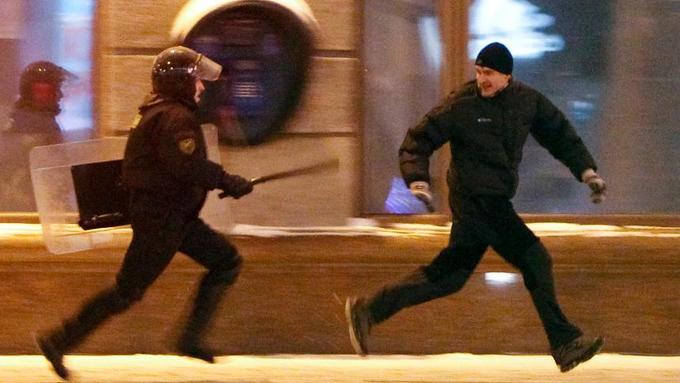
The shot was taken in the evening or at night on a city street: there is snow on the sidewalk, and lights are reflected in a glass shop window. On the right a person runs in a black jacket, dark trousers, a knitted hat and gloves. They look back at the pursuer and run with fast, sweeping strides. On the left, behind them, runs a person in black uniform and a helmet with a transparent visor, with a transparent shield in one hand and a baton in the other. In the background another person in a helmet is visible.
The frame caught a moment where all the dynamics read instantly: two figures in the same phase of running, a small distance between them, and the face of the runner turned toward the viewer almost as if they are weighing their chances. Blurred lights and a snowy curb create a sense of speed.
What is known about the origin
Information about where and when the picture was taken and who its author is has not been found in verified sources. The photo is often linked to a street protest, but there is no confirmation of this, and neither the city, the date, nor the photographer can be reliably named. Therefore, instead of the history of an event, it is better to talk about how the photograph lives on the internet.
It is also important that the frame shows real people, not actors. The person running in the photo has nothing to do with the jokes captioned over it, and attributing actions, views or motives to them is not acceptable. What got into the meme is the outward appearance of a situation, not someone's biography.
Why the picture works
The photo reads without a caption: someone is chasing, someone is running away. The roles are simple, and any user can put what they want to avoid in the pursuer's place, and themselves in the runner's place. The helmet and baton make the pursuer threatening, while the runner in ordinary winter clothes looks defenseless and therefore funny and recognizable.
The runner's turned head adds a comic detail: they are not simply running, they are keeping an eye on the chase. This is useful for jokes about putting things off, when a person understands the problem is close but keeps running anyway.
Caption examples
“Me on Monday morning” above the runner and “My alarm clock” above the pursuer: the joke is built on an everyday confrontation where the same participant always loses.
“The player who found the bug with infinite resources” and “The developers preparing the fix” make the roles show a race against time.
“Me, not answering a message for the third day” and “A polite reminder in the chat” replace the pursuer with something gentle but persistent, and the contrast with the threatening photo strengthens the joke.
“My deadline” and “Me” show that the template can also be used in reverse, when the task itself is the one catching up.
How to use the template
It is best to choose everyday occasions: chores, calls, reminders, debts, cleaning. The caption should be placed right on the figures or next to them, so it is clear who is who. Serious political and force-related topics are better avoided: the photo shows a real event, and a joke over it easily becomes tactless.
For short posts one caption on the pursuer is enough, and the runner can be left without text: the viewer will put themselves in their place.