The original photo
The original photograph is tied to the documentary interview that the American director Oliver Stone conducted with Vladimir Putin. Dmitry Peskov, the president's press secretary, was captured holding a microphone during the filming. The exact circumstances of the shot and the filming date are not known. Shots like this often end up in news feeds as isolated stills, and without the context of the interview the viewer sees only a pose and a facial expression, which is exactly what becomes the basis for further edits.
The meme arose because, in the photo, the press secretary's figure ended up in a setting that bears little resemblance to journalistic work. The photo itself became material for internet parodies precisely because it was easily recognizable and allowed for edits without losing its sense.
The mechanics of the photoshops
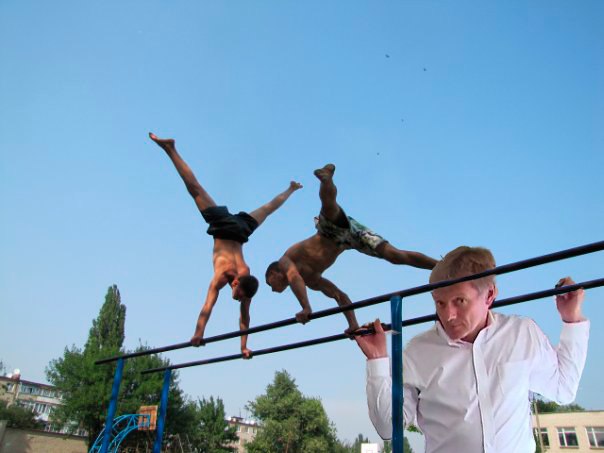
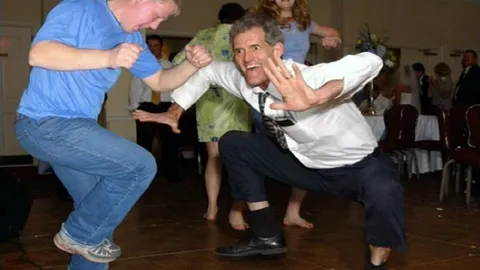
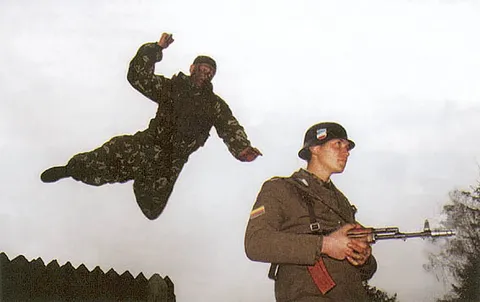
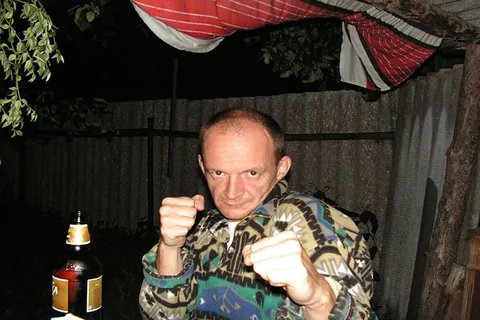
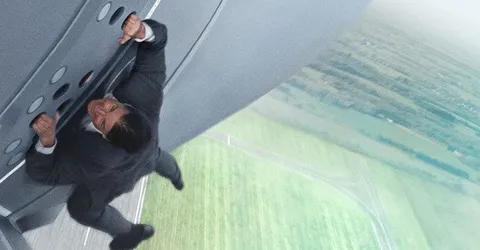
The genre is built on a simple device: Peskov's figure is cut out of the original shot and inserted into other scenes. That's how he ends up next to acrobats on a bar, in city landscapes, and in historical scenes. The comedy comes from the mismatch between place and behavior: a serious official figure finds himself in an everyday or sporting setting. It matters that the cut-out figure keeps the lighting of the original shot, so the edit can look convincing even with rough edges around it.
The illustration is a composite in which a figure in a white shirt holds onto a bar while, in the foreground, two people perform acrobatic tricks against a bright blue sky. The effect rests on the contrast between the solemn figure and the lighthearted background, and it's exactly that contrast that makes the shot recognizable.
Political context
The meme belongs to political humor, and that's worth keeping in mind. A public figure's press secretary, his words, and his public image are widely discussed, and the photoshops serve as a form of satirical commentary on that public role. The press secretary's public role entails constant attention from journalists, and it's exactly that attention that turns any shot of him into potential material for parody. This article describes the meme factually and neutrally, without passing judgment on the politics or personal qualities of those involved.
Photoshops of this kind spread mainly through social media and humor sites. Their authors are usually unlisted, and the exact chronology of the series hasn't been established in the course of this work. Such series are often updated whenever new occasions arise, and each version relies on the same device. A reader can compare different versions of the series and see how the occasions changed — from everyday scenes to news events — and how the same composition kept moving into new contexts.
Significance for the meme
The series shows how one successful shot can spawn an entire genre. The photoshops work through the recognizability of the figure: viewers immediately understand who is depicted and see the edit. That's why even new versions keep the core of the joke and are easily read without a caption. This makes the series convenient to retell in comments and ironic captions. That's why even people who don't know the original interview find the photoshops recognizable and funny.
The meme also illustrates a broader practice of the Russian-speaking internet: public figures become subjects of parody, and such jokes are seen as part of political humor. Their longevity depends on the news cycle, so some versions eventually lose relevance and survive only in image archives. Occasionally individual versions become noticeable only within a narrow circle before disappearing from feeds, and only saved image collections make it possible to reconstruct their history.